Weekly geopolitical storylines
IR Lens
Week 2026-W41 · 10 October 2026
|
Editor's note A couple of big updates this week. First, the digest now arrives on Saturday (so I can do the editorial on Friday). The digest often references previous issues, it now hyperlinks to them, you can read them on the website. Third, every storyline now has its own dossier overview and dashboard on the website. There you can find (even more) details. One thing I find particulary interesting is the 'what to watch for' bit, basically predictions. I'm working on tracking them more actively and seeing how many actually come true. Should we do more with that? let me know! |
This week's damage landed on supply and infrastructure rather than on fighting forces Because those targets are cheap to reach and the usual reply to hitting them is a statement: Danish arms makers and Riyadh's airport were both struck, and neither victim has yet imposed a cost. The cost-avoidance reading is inferred from the sequence, and no government has said it.
We're seeing that European governments are increasingly openly pointing at Russia as the guilty party for the hybrid attacks. This week Denmark's government confirmed that Russia has sabotaged its defense firms. We expect that this will be a trend: other European governments will start to point at Russia for the hybrid attacks by year-end.
|
In this issue 01 The Ukraine war — Washington's top diplomat now says no settlement is in sight, and both sides escalated strikes this week, so the US track keeps moving without a basis for a deal. 02 US–Iran confrontation and Middle East realignment — US pressure on Iran eased this week, while Saudi Arabia's war with the Houthis worsened: Riyadh's airport was hit and three people died. 03 Europe's struggle for strategic autonomy — A UK bid to bring Germany into GCAP and a reported US-Russia Nord Stream probe both move European choices to London and Washington, though neither is confirmed. 04 US–China power transition — China opened its first military foothold on mainland Southeast Asia, in Laos. It is small, but it is the first new forward position on China's side in this record. 05 Russia's pursuit of great-power status — Denmark's intelligence service says Russian sabotage has already hit Danish defense firms, but no service is named and Europe has so far answered with sanctions and statements. |
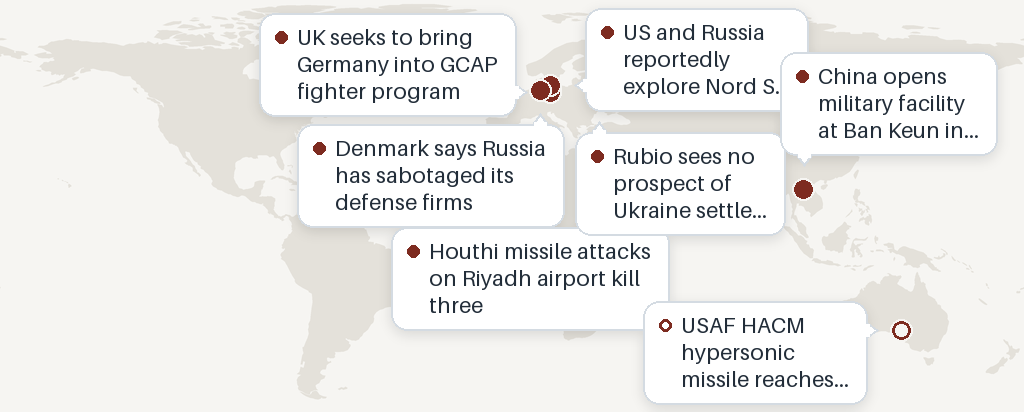
● this issue
Storyline I
| dormant | background | elevated | hot | critical |
5.9 of 10 · cooling ↘
|
This week · Complication Rubio now calls the war a stalemate with no settlement in sight, because Russia still demands all of Donetsk, and nothing reported suggests the new US proposals touch that demand. Witkoff and Kushner are still due in Moscow by October 31, but this week's reporting did not mention the UAE round proposed in W39. Both sides meanwhile raised strike pressure: Russia killed at least 55 civilians in Kramatorsk and Pryluky and vowed more attacks on defense industry, while Ukraine hit the Omsk refinery and a Yandex data center. The FP-7 launch (W40) still has no published target, so Kyiv's added leverage is unproven. The fighting is intensifying while the one demand blocking a deal has not moved. |
Rubio sees no prospect of Ukraine settlement as US envoys prepare new proposals
In an Oct 8 Kathimerini interview, Rubio called the war a "strategic stalemate" with no prospect of settlement, citing Russia's demand for all of Donetsk. Zelensky replied that Washington should not call peace impossible while declining to pressure Putin. Axios reported that Witkoff and Kushner briefed Trump and European officials on Oct 8, will present "new ideas" to a Ukrainian delegation on Oct 9, and plan to visit Moscow by month-end.
| Alliance Politics (Entrapment–Abandonment) | Zelensky's reply targets abandonment risk: a patron that declares the war unsettleable without raising Moscow's costs leaves Kyiv to absorb the stalemate. The sequence Axios describes is Trump, then UK, French and German advisers, then Kyiv on Oct 9, then Moscow. That order is inferred to put Kyiv third in line, which resembles the imposed-terms pattern flagged at W36-W37. Next: Within 72 hours of the Oct 9 meeting, Zelensky or his delegation will describe a document or framework 'received' or 'to be reviewed' rather than co-drafted (~60%). |
| Deterrence Theory | Rubio named the exit from stalemate as either a settlement or escalation spreading beyond Ukraine, and cited the Black Sea ship attacks as an example. That is a US official describing spillover risk without announcing any cost on Russia, which fits the leverage-free posture tracked since W36-W37. Moscow's incentive is to accept the talks while keeping the Donetsk demand, since nothing has made refusal costly. Next: Before the Moscow visit, the US announces no new sanctions, tariffs or weapons-pipeline decision explicitly tied to Russian negotiating conduct (~80%). |
| Analogue | Korean War armistice talks, 1951-53 — Negotiations ran alongside fighting for two years after the front stabilized, with a territorial line and a mediator-style US role in dispute. Where it breaks: In Korea the line of contact was largely accepted early, whereas Russia demands Donetsk territory it does not hold and Ukraine rejects ceding it. |
Also this week
— Russian strikes kill dozens in Kramatorsk and Pryluky — A guided-bomb hit on buses killed 33 and a missile strike on an apartment block far from the front killed 22, and Moscow's promise to intensify attacks on defense-industry targets, if carried out, would put Ukrainian missile production sites at risk.
— Ukrainian drones hit Omsk refinery, Yandex data center, Tver, Kaluga and a Sochi tanker — The strikes continue the established deep-strike campaign, reaching Russia's largest refinery and civilian digital infrastructure, and Kyiv's answer to Moscow's strikes is more of the same.
— Denmark says Russia sabotaged its defense firms — Danish intelligence adds a third country to the sabotage record that already covers Ukrainian and German defense facilities, which raises the exposure of Western production sites supporting Ukraine.
— South Korea recalls ambassador over North Korean POW disclosure — Zelensky's public statement that two North Korean prisoners had been transferred to Seoul broke a confidentiality agreement and strained a partner relevant to the DPRK-support question, without affecting the war itself.
What to watch for in the upcoming weeks
— Whether the Moscow visit happens before Oct 31, and whether the Kremlin restates the Donetsk withdrawal demand
— Any leak or readout from the Oct 9 Ukrainian briefing showing a Donetsk-specific arrangement
— Ukrainian or OSINT target and damage evidence for the FP-7 launch, within about three weeks
Storyline II
US–Iran confrontation and Middle East realignment
| dormant | background | elevated | hot | critical |
5.7 of 10 · steady
|
This week · Complication Trump said the US will not strike Iran before the midterms, probably because of oil prices and the vote (our inference), and a carrier group and the B-1s at England have left, so US pressure on Iran eases for now. Yemen moves the other way. Saudi-backed Yemeni forces claim to have retaken Mokha, and the Houthis answered by hitting Riyadh's airport, with the first deaths at this scale. Iran's six-day Hormuz offer from W39 still has no public US reply, and no Iranian components or Pakistani and Turkish forces have been confirmed. The US is easing off while Saudi Arabia's war with the Houthis grows. |
Houthi missile attacks on Riyadh airport kill three
Houthi missiles and drones hit Riyadh's international airport and a second Saudi airport, killing three and injuring dozens, and flights were cancelled in bulk. Saudi authorities said they intercepted two more missiles aimed at Riyadh the next day. Reports differ on the dead: the Saudi government named two women and a Sudanese man, the Guardian says three Saudis, and SCMP includes a pilot. The strikes came about a week after Saudi Arabia and allied forces launched an offensive in Yemen.
| Deterrence Theory | Saudi denial failed where it costs most. Interceptors stopped two missiles the next day, but the first wave killed three, and the mass cancellations imposed the cost whatever the hit rate. Target depth has increased from Jazan (W37) to Taif and Yanbu (W39) to the capital's airport. Known: the strike followed the offensive within days. Inferred: it is retaliation meant to raise the offensive's price. Saudi airstrikes have not suppressed it. Next: Another Houthi missile or drone attack on Riyadh or a Saudi civilian airport is reported within 3 weeks (~75%), whatever the offensive's progress. |
| Alliance Politics (Entrapment–Abandonment) | Pakistan's PM drew his red line at Mecca and Medina (W39), and Riyadh is outside it. Islamabad and Ankara can therefore stay consultative while the capital is hit. This is consistent with Saudi Arabia fighting on its own air force and imported interceptors while the US is stretched across Hormuz and the Red Sea (W34, W36). Riyadh's abandonment fear rises; Pakistan and Turkey have no entrapment pressure yet. Next: Pakistan or Turkey announces air-defense units or personnel deployed to Saudi Arabia within 4 weeks (~15%); the likelier output is statements only. |
| Analogue | Houthi missile launched at Riyadh's King Khalid airport, November 2017 — Houthis answered coalition pressure by targeting the capital's airport to show Saudi air defense could not guarantee protection. Where it breaks: In 2017 the missile was intercepted with no deaths, Saudi Arabia still had the East-West pipeline bypass, and no US-Iran war was running; now people died, the pipeline has been disrupted (W38, W39) and Washington's attention and munitions are split (W32). |
Also this week
— Trump says no Iran strike before midterms — Oil fell on the statement, but it sets only a timing limit and leaves the blockade and the unanswered Hormuz offer in place.
— US carriers and bombers rotate out — Abraham Lincoln is home and Bush is in port, leaving one carrier group in the region, which lowers sustained strike capacity just as Washington signals no strikes are planned.
What to watch for in the upcoming weeks
— Whether Saudi ground units, not only Yemeni allies, take part, and whether Mokha stays retaken (2-4 weeks)
— Any public US accept, counter, or reject on Iran's six-day Hormuz offer (1-2 weeks)
— Riyadh airport traffic and whether foreign carriers suspend service (about two weeks)
Storyline III
Europe's struggle for strategic autonomy
| dormant | background | elevated | hot | critical |
5.5 of 10 · steady
|
This week · Advance Two reports this week show decisions on European autonomy being made outside EU institutions. The UK says it is working to move Germany from the stalled FCAS to GCAP, though only London's side is on record and Italy and Japan have not consented. The Moscow Times, on anonymous sources, says Washington and Moscow are exploring a Nord Stream restart, while Rubio calls the war a stalemate and Witkoff and Kushner plan a Moscow trip. Berlin answered at ministry level, on sanctions law, and Merz is weakened at home. Europe's fighter and gas choices are being shaped by London and Washington as much as by Brussels. |
UK seeks to bring Germany into GCAP fighter program
Breaking Defense reports that the UK says it is seeking to progress a possible German switch from FCAS to GCAP, the UK-Italy-Japan sixth-generation fighter program. Berlin has been exploring next-generation fighter options since FCAS collapsed this summer. The report gives only the UK side. No German commitment, GCAP partner consent (Italy, Japan), or terms are confirmed.
| Alliance Politics (Entrapment–Abandonment) | Germany lost its French partner and needs a successor to the Eurofighter that keeps Airbus in fighter work. The UK wants German money and volume to spread GCAP's development cost. Known: London is courting Berlin. Inferred: Berlin is using the approach as leverage on workshare while France flies the Rafale F5. The fear driving Germany is abandonment by Paris, and this extends the UK-Germany bilateral track noted in W35. Next: Germany will sign no binding GCAP accession (GIGO membership or treaty) within 12 months (~80%), but will announce a study, MoU, or observer arrangement within 6 months (~35%). |
| Economic Interdependence & Weaponization | Fighter programs are decided by design authority and export licensing. Germany's export vetoes were a suspected friction in FCAS (inferred; the tracked Rafale export question tests it). GCAP would put Berlin under partners with their own export interests: Japan's rules on arms transfers, and British and Italian interest in Gulf sales. The chokepoint is the same and the partners are new. Next: Within 4 months, Italian or Japanese officials will publicly state conditions on German entry tied to workshare or export policy (~50%). |
| Analogue | France's 1985 exit from the Eurofighter project over workshare and design control, leading to the Rafale — The same industrial split between a French national fighter and a multinational one, with the roles now reversed. Where it breaks: Germany would be joining a program with fixed design leadership and a roughly 2035 in-service target, so it cannot demand the design authority it sought in FCAS. |
US and Russia reportedly explore Nord Stream restart
The Moscow Times, citing unnamed sources, reports that the US and Russia are exploring a Nord Stream restart. A spokeswoman for Germany's economy and energy ministry replied that Nord Stream and Russian gas are sanctioned in Europe. The report gives no participants, scope, or timeline. The ministry's reply addresses the legal status of the pipeline and does not confirm or deny the talks.
| Alliance Politics (Entrapment–Abandonment) | Berlin's reply cites European law and does not deny that the talks exist, which is how a party outside the room responds. Moscow gains if Europe sees Washington treating its gas market as a bargaining chip, and a peace-deal sweetener is the likely US motive (inferred). This turns W38's AfD-hosted Witkoff/Kushner invitation into a possible channel that bypasses Berlin altogether. Next: The White House or State Department will not publicly confirm a Nord Stream discussion with Russian officials within 6 weeks (~70%); expect denial or silence, with Moscow (Dmitriev or Peskov) tying restart to a peace deal. |
| Economic Interdependence & Weaponization | Nord Stream was Russia's chokepoint over Germany until the 2022 sabotage and EU sanctions removed it. A restart would give Moscow back that leverage while Germany carries the supply-dependency risk. US LNG exporters, who gained German market share after 2022 (inferred), would lose from it. That makes the report as consistent with Russian signaling aimed at a US-EU wedge as with real talks. Next: No EU legal act relaxing Nord Stream or Russian gas restrictions will be proposed within 6 months (~95%); the live risk is Hungary or Slovakia linking sanctions renewal to the pipeline (~20%). |
| Analogue | Siberian pipeline dispute, 1981-82 — Pipeline gas from the USSR became the point where Washington and West European governments split over how to treat Moscow. Where it breaks: Reagan opposed the pipeline and sanctioned European firms, whereas here the US is reportedly on the Russian side of the table and Germany is the one invoking sanctions. |
Also this week
— Rubio sees no Ukraine settlement; Witkoff and Kushner to visit Moscow — The planned Moscow trip is the channel through which a Nord Stream restart could be raised, so it is the nearest test of the anonymous-source report.
— US B-1B bombers leave RAF Fairford — The reported cause is the threat of a close-range drone attack, and the departure exposes the lack of hardened shelters at UK bases, the same counter-drone gap behind this autumn's eastern-flank warnings.
— EU announces 46 critical mineral projects — A Commission-level autonomy measure aimed at China, in a policy area where EU-level action is less contested than in defense procurement.
What to watch for in the upcoming weeks
— Whether Nord Stream appears in Witkoff and Kushner's Moscow talks, this month
— Whether Merz or the Chancellery publicly rejects a Nord Stream restart, through next quarter
— A formal German GCAP step (MoU, GIGO accession, observer status) and Italian and Japanese consent, within 12 months
Storyline IV
| dormant | background | elevated | hot | critical |
5.3 of 10 · heating ↗
|
This week · Advance China opened a military facility at Ban Keun in Laos, its first foothold on mainland Southeast Asia, after months of mostly allied-side moves. Known: eight light attack aircraft, a dozen-plus vehicles, a runway that takes only small jets. Beijing probably wants to complicate US operations in the South China Sea from the west (inferred), but the site changes positioning, not the balance. Manila's report that Chinese vessels near contested features nearly doubled in September and the wider mobilization law are consistent with that direction, while Washington prepares for a November Shenzhen summit. A base called a training centre is judged by what gets built on it later. |
China opens military facility at Ban Keun in Laos
A Chinese 'support and training centre' opened last week at Ban Keun airport in Laos. Vantor satellite images show eight light attack aircraft and more than a dozen military vehicles. The runway currently handles only small jets. Beijing says the facility is 'not directed at any third party'. The PLA Air Force now has its first foothold in mainland Southeast Asia.
| Deterrence Theory | Beijing is gaining access first and capability later. Light jets from an inland airfield add little range toward Taiwan or the Spratlys (inferred), which fits The Diplomat's 'limited direct threat' assessment. The probe is a sequence: training label, small jets, then longer runway, shelters, fuel. Each step is deniable, and no single step gives Thailand, Vietnam or the US a clean trigger to object. Next: Commercial imagery will show a runway extension, hardened shelters or fuel storage at Ban Keun within 12 months (~25%). |
| Alliance Politics (Entrapment–Abandonment) | Laos probably consents because of its financial dependence on China (inferred from its known debt exposure), so the cost of the decision falls on neighbors, not on Vientiane. Thailand, a US treaty ally, shares a long border with Laos. Vietnam hedges and has little room to object to a host's choice. This is the same swing-state calculus the WAICO entry raised for Indonesia, now with a physical footprint. Next: Within one month a US State or DoD statement on the facility is likely (~50%), while Thai or Vietnamese comment beyond 'monitoring' is less likely (~25%). |
| Analogue | China's Djibouti base (2017) — Beijing first described it as a 'support facility' and it became the PLA's first overseas base. Where it breaks: Djibouti is a coastal naval site that China openly called a base, while Ban Keun is an air facility on a host airport, has no sea access, and is labelled as training. |
Also this week
— China and Philippines trade blame over Second Thomas Shoal medical evacuation — The dispute is a routine blame exchange, but Manila's count of Chinese vessels nearly doubling in September raises the stakes of the next Sierra Madre resupply.
— Bessent may skip Apec finance meeting ahead of Trump's Shenzhen visit — Prioritizing summit preparation over the multilateral meeting fits the bilateral pattern and feeds Japanese fear of a deal made over its head.
— China revises defense mobilization law — The law widens the conditions for declaring mobilization and obliges private firms to support the state in wartime, which adds to wartime-readiness evidence without any named target or system.
— EU and China hold crunch trade talks in Beijing — Beijing's offer to keep fast-tracking rare earth licences and an understanding on hybrid vehicles show it using economic access to ease pressure from Europe while it expands militarily.
What to watch for in the upcoming weeks
— Imagery showing Ban Keun's runway lengthened, or hardened shelters and fuel storage added, within 12 months
— Whether the next Sierra Madre resupply proceeds unobstructed, within about 2 months
— Whether Thailand or Vietnam publicly seeks clarification from Laos on Ban Keun, within 3 months
Storyline V
Russia's pursuit of great-power status
| dormant | background | elevated | hot | critical |
5.3 of 10 · steady
|
This week · Advance Danish intelligence now says Russia has already sabotaged Danish defense firms, which turns the probabilistic warning of W39 into confirmed attacks on the supply chain. The reporting names no company, method, date or Russian service, so whether the GRU or hired local proxies did it is open, and no government has joined this case to Leipzig or Brandenburg. Europe answered with tools it already had: about 1,600 new EU sanctions listings, UK sanctions covering 90% of Russian oil output, and Baltic troop moves. Washington's track stayed commercial, with the Trump-backed Lukoil asset sale. Russia is hitting the factories that arm Ukraine, and no government has yet named who did it. |
Denmark says Russia has sabotaged its defense firms
A lead analyst at Danish intelligence, Josefine Christensen, said Russia has carried out sabotage attacks against Danish defense firms and called it a significant escalation. The reporting provided does not name the companies, the methods, the date of the incidents or the Russian service responsible. Atlantic Council commentary places the case within the Leipzig-to-Black Sea sabotage, arson and cyber pattern.
| Deterrence Theory | Russia's likely incentive is to slow the defense industrial base, the constraint on both Ukraine supply and the EDA's unreachable 2030 readiness goal (W39). That is inferred from target choice, not stated. Danish disclosure is communication without cost, like the Telegraph's naming of Levushkin and Karshakov (W40). No state has yet attached a penalty to any of these incidents. Next: Denmark announces no expulsions, sanctions listings or other punitive measure against Russia over these incidents within six weeks (~65%); protective requirements for defense firms are more likely (~45%). |
| Alliance Politics (Entrapment–Abandonment) | Hosting and financing arms production for Ukraine moves the entrapment cost onto the supplier state, and private firms absorb the first hits. Sabotage of a company is below any Article 4 or 5 threshold, so the alliance has no ready collective response. Denmark's public attribution is the only signal so far; no US statement is reported. Next: Neither Denmark nor any other ally requests Article 4 consultations over sabotage of defense firms before year-end (~90%); responses stay national or EU-level. |
| Analogue | GRU Unit 29155's 2014 Vrbětice ammunition depot explosions in Czechia, attributed in 2021 — Sabotage aimed at arms supply chains feeding Ukraine, run by deniable operatives. Where it breaks: Czechia attributed seven years later after a single depot incident, while Denmark is naming a campaign against producing firms within what looks like months, during open war and a European rearmament drive. |
Also this week
— Baltic states reinforce borders; Lithuania moves to lift nuclear-arms ban — Estonia shifted troops to its Russian border and Lithuania sent about 100 soldiers to the Kaliningrad border while moving to lift its nuclear-arms ban, drawing a Kremlin escalation warning that fits the established tit-for-tat pattern.
— EU and UK expand Russia sanctions — The EU added about 1,600 listings (total near 4,650) and the UK extended coverage to 90% of Russian oil output, so Europe is tightening while the US-Russia channel discusses commercial deals.
— Lukoil international assets go mainly to Middle Eastern funds — The Trump-backed sale moves Russian-owned assets in Bulgaria and Romania to Gulf-linked owners, which is consistent with sanctions pressure forcing divestment without a settlement.
— EU warns of winter gas shortfall — A projected shortfall equal to the power use of 12 million homes reports European vulnerability, not a Russian action, and keeps energy leverage relevant to the AfD gas-restart outreach.
What to watch for in the upcoming weeks
— Any government attributing the Danish defense-firm sabotage to a named Russian service or to hired proxies
— Another EU or NATO intelligence service disclosing comparable sabotage of its defense firms within three months
— OFAC license, waiver or delisting for Russian oil firms before a ceasefire framework, within eight weeks
|
Wildcard USAF HACM hypersonic missile reaches flight-test release in Australia — The USAF's scramjet-powered Hypersonic Attack Cruise Missile has reached flight testing, with at least one release carried out over an Australian range after significant delays. (HACM's transition from development to operational flight testing is a concrete threshold-crossing in US hypersonic capability deployment (not merely continued R&D), directly involves major-power military competition with China, and plausibly seeds a new strategic storyline around hypersonic arms race and Pacific deterrence — though the event's significance is somewhat muted by the weapon remaining pre-operational and Australia's subordinate role in what is fundamentally a US technological milestone.) — possible new storyline? |
|
Idea or discussion? Hit reply. irlens.apps.pompadour.ventures |