Weekly geopolitical storylines
IR Lens
Week 2026-W38 · 20 September 2026
|
Editor's note Dear reader, I am offline this week. I decided to send out the digest anyway, without editorial edits from my side. Normal service resumes next week, the 27th of September. |
What connects a Lithuanian shootdown, an AfD delegation courting the Kremlin, and a dark Saudi pipeline? Each is a threshold test, probing how much pressure a formal red line absorbs before it moves, and the mechanism is cost, not conviction: cheap probes are how you find where the line sits. It held everywhere this week.
What matters most is whether it keeps holding over the Baltic, where Latvia's air-defense chief says the gap is technological rather than political. Russia's strikes are a volume game, and volume produces a casualty, at which point NATO's muted posture likely breaks: call it one in three before winter. Watch Vilnius, not Brussels.
|
In this issue 01 Europe's struggle for strategic autonomy — The Russian threat that justifies Europe's rearmament sharpened this week, but so did the domestic German politics that could someday reverse it. 02 US–Iran confrontation and Middle East realignment — Energy shocks now hit Europe and Asia directly while Iran gains diplomatic cover through BRICS, showing the anti-Iran coalition fragmenting even as costs mount. 03 Russia's pursuit of great-power status — Russia's hybrid campaign jumped from Germany to Lithuania and France this week, while Washington kept pressing Kyiv toward accommodation rather than punishing Moscow. 04 The Ukraine war — no significant movement. 05 US–China power transition — no significant movement. |
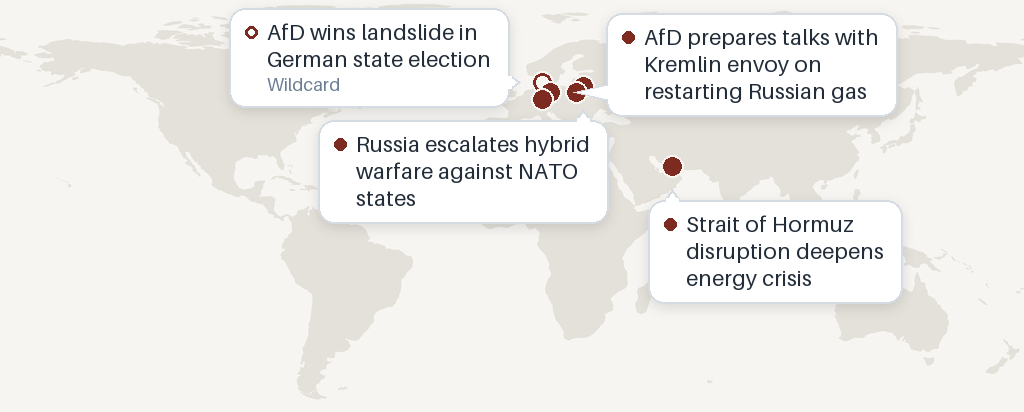
● this issue
Storyline I
Europe's struggle for strategic autonomy
| dormant | background | elevated | hot | critical |
7.5 of 10 · heating ↗
|
This week · Complication This week's two deep dives pull the arc in the same direction from opposite ends: the Lithuania shootdown and Rinkēvičs's obsolescence warning confirm, almost on schedule, the W35 prediction that a probing incident would test NATO's eastern-flank gap, and validate the urgency behind Germany's €12B missile program and France's all-domestic Rafale F5 push. But the AfD-Kremlin gas talks expose that the domestic political consensus underwriting that entire buildup, energy decoupling from Russia, is not as settled as the prior four weeks of national/bilateral capability-building assumed; AfD's Saxony-Anhalt landslide the same week makes that channel look less like fringe theater and more like a live variable for 2029 coalition math. The net effect is that Europe is racing to build hardware against a threat that just got more concrete, while the political foundation in its largest economy for sustaining that posture past this decade looks measurably shakier than it did in the consolidated W29-W30 read. Every capability entry this quarter, from missile programs to drone plants to Rafale F5, still bypasses EU institutions in favor of national or narrow bilateral tracks, and nothing this week reversed that. Europe's rearmament is answering an increasingly real military threat with real money, but it is doing so on a domestic political runway that is shorter, and less bipartisan, than the hardware timelines assume. |
AfD prepares talks with Kremlin envoy on restarting Russian gas
AfD co-chairs Weidel and Chrupalla are preparing talks with Kremlin Direct Investment Fund head Kirill Dmitriev, possibly as early as March 2027, contingent on a Russia-Ukraine peace agreement being in place by then. Reuters reports plans to invite US officials Steve Witkoff and Jared Kushner, though neither has accepted. AfD holds no government power, so any outcome is symbolic, but mainstream German politicians (Greens' Kellner, CDU's Kiesewetter) are already calling a Nord Stream restart treasonous and a security disaster.
| Economic Interdependence & Weaponization | This is Moscow cultivating a domestic political proxy to reopen a chokepoint it lost when Nord Stream was sabotaged and sanctions locked in, since it cannot reopen that channel through Berlin's current government. AfD gets a foreign-policy credibility prop for voters; the Kremlin gets a standing narrative that German energy dependency is one election away from resuming, which itself has coercive value even before any gas flows. Next: Expect the Merz coalition to issue an explicit statement or propose legal restrictions on party-level foreign energy negotiations within 2-3 months (~50% probability); absent that, treat Berlin's silence as tacit tolerance of the overture as a test balloon. |
| Alliance Politics (Entrapment–Abandonment) | The floated Witkoff/Kushner invitation matters more than the AfD's own weight, since it raises the possibility of a White House-adjacent channel discussing German energy policy outside Berlin's government entirely, which would sharpen abandonment fears among Merz's coalition partners about being cut out of decisions on their own dependency exposure. AfD's incentive is pure domestic signaling; it needs no actual Kremlin concession to claim the meeting as a win. Next: If Witkoff or Kushner formally accept the invitation within the next 2 months, that confirms a genuine US-level interest in reopening this channel independent of the German government (~30% probability); refusal or continued non-response keeps this a purely AfD-initiated messaging exercise. |
| Analogue | Gerhard Schröder's post-chancellorship Gazprom/Nord Stream board roles — A German political figure serving as a personal channel for Russian energy re-engagement, legitimized by domestic political standing rather than formal state authority. Where it breaks: Schröder had real access to SPD establishment networks and sat on the pipeline company's board; AfD holds no executive levers and cannot actually authorize a restart absent a change in government or sanctions law. |
| Analogue | Kremlin financing of Marine Le Pen's Front National (2014 Russian bank loan) — Russia cultivating a European far-right party as a long-term asset for sanctions relief and normalization narratives. Where it breaks: Le Pen's party was financially dependent on Moscow; AfD's overture here looks self-initiated and opportunistic, timed to a hoped-for peace deal rather than driven by Russian funding leverage. |
Russia escalates hybrid warfare against NATO states
A Russian Gerbera drone was shot down over Lithuania and intercepted by a NATO jet, the first such shootdown in the country's history, following earlier cruise-missile and drone incidents in Poland and Germany. Tusk publicly framed Russian strategy as deliberately 'accidental' strikes designed to weaken Article 5 resolve without triggering it, while Latvia's president warned NATO's air defenses could be technologically obsolete within a year. Macron ordered infrastructure hardening and called an emergency G7 meeting on energy and the hybrid threat, and NATO's Allied Air Command detailed new counter-drone and cruise-missile plans, even as baseline estimates downplay the odds of a direct Baltic incursion.
| Deterrence Theory | This is salami-slicing made explicit: Tusk is describing, not inferring, a Russian strategy of calibrated ambiguity built to sit just below the threshold that would force NATO to invoke Article 5. The shootdown shows denial-based deterrence functioning tactically (the jet worked), but the unresolved attribution debate, Ukrainian stray versus deliberate Russian probe, is exactly the credibility gap the strategy is designed to exploit. Next: Expect at least one further Russian-attributed airspace incursion (drone or missile) into NATO territory within 2-3 months, calibrated to preserve deniability (~65% probability); an actual Article 5 invocation over any single incident stays unlikely (~10%) absent casualties or destroyed infrastructure. |
| Alliance Politics (Entrapment–Abandonment) | Baltic and Polish assertiveness here (public warnings, shootdowns, evacuation planning) reads as smaller allies leaning on the alliance's reassurance obligations while simultaneously worrying those obligations won't hold, classic abandonment anxiety rather than moral hazard. The patron-level response (NATO's new air-defense plan, Macron's convening role) is reassurance, but it arrives as doctrine and meetings, not deployed capability, which is precisely the gap Rinkēvičs is calling out. Next: Watch for Lithuania or Poland to request formal NATO Article 4 consultations after any further incursion within 3 months (~40% probability); the alliance response will most likely be announced eastern-flank air-defense reinforcement without a change in Article 5 posture or new binding funding commitment. |
| Economic Interdependence & Weaponization | Macron folding the hybrid threat into the same emergency meeting as energy prices shows the campaign's costs bleeding into the economic track already flagged in this arc (Gulf outreach, fiscal squeeze), not staying contained to security policy. Next: Expect the G7 energy meeting to produce coordinated messaging on strategic reserve releases within weeks (~50% probability) but no new sanctions package tied specifically to the hybrid campaign in that window (~15% probability one emerges). |
| Analogue | Crimea/Donbas 2014 'little green men' — Deliberately deniable forces used to achieve gains while denying the target state a clean casus belli. Where it breaks: That operation unfolded outside NATO territory; drones over Lithuania and missiles into Poland directly implicate Article 5, raising the stakes of the same playbook considerably. |
| Analogue | Cold War Soviet bomber probes of NATO air defenses — Repeated incursions designed to test reaction times and alliance cohesion without provoking war. Where it breaks: Those were marked, manned aircraft with unambiguous state attribution; today's drones offer genuine deniability (Ukrainian stray vs. Russian intent), which is the whole point of the current tactic. |
Also this week
— AfD wins landslide in Saxony-Anhalt — Directly reinforces the AfD-Kremlin deep dive by showing the party's electoral momentum is real, not marginal, ahead of any 2027 gas-restart theater.
— Germany receives first F-35 jets — A concrete near-term capability gain that nonetheless deepens rather than reduces US-platform dependence, which cuts against the autonomy framing even as it satisfies NATO burden-sharing.
— France unveils 2035 national security plan — Doctrinal confirmation that Paris sees maritime and space domains as the next contested frontier, consistent with but not yet operationalizing the arc's trajectory.
— EU proposes 'associate membership' for Canada — A trade-driven institutional hedge against US friction that signals alignment-seeking outside Washington without touching defense procurement or capability.
What to watch for in the upcoming weeks
— Whether Witkoff or Kushner formally accept or decline the AfD invitation (watch within weeks to a few months)
— Progress or stalling of a Russia-Ukraine peace deal, the stated precondition for the meeting (watch through 2026 into early 2027)
— Any Merz-government statement or legislative proposal addressing party-level foreign energy diplomacy (watch within 2-3 months)
— AfD polling movement specifically tied to this initiative in national surveys (watch over next 2-3 months)
— Kremlin MFA or Dmitriev public statements on conditions for Nord Stream restart tied to a peace deal (watch within weeks to months)
— Formal NATO or national attribution of the Lithuania Gerbera drone to Russian intent versus Ukrainian stray-drift (watch weeks)
— Any Article 4 consultation request from Lithuania or Poland following a further incursion (watch 3 months)
— Funding source and institutional home (NATO command budget, national, or EU/PESCO) of the new Allied Air Command counter-drone plan (watch 3-6 months)
— Outcome and date of Macron's G7 energy meeting, including any strategic reserve release announcement (watch weeks)
— Any casualty-producing or infrastructure-destroying incident attributed to Russia on NATO territory (watch 6-12 months)
— Bundestag or French budget debate explicitly citing this incursion wave to justify accelerated air-defense or drone-interceptor spending (watch weeks to months)
Storyline II
US–Iran confrontation and Middle East realignment
| dormant | background | elevated | hot | critical |
6.8 of 10 · steady
|
This week · Complication The week's mechanism is a widening gap between rising material costs and shrinking political cohesion: Saudi Arabia's East-West pipeline, its own decades-old Hormuz hedge, has gone offline, pushing crude past $100 and stripping Asian refiners of the buffer W37's dual-chokepoint framing assumed still existed, while a separate Aramco drone strike cut October crude to European contract holders, extending the diesel shock (W36) and UAE embargo (W34) into a third transmission channel. Simultaneously, BRICS extended Iran multilateral diplomatic cover with India's unexpected co-sign even as the UAE, a BRICS member, maintains its own bilateral financial embargo; punishment and legitimacy now run on decoupled tracks rather than reinforcing each other. Saudi Arabia continues buying US hardware (F-35) and absorbing Houthi pressure (Riyadh air alerts, Marib collapse) without invoking the Mecca pact, while South Korea's public troop refusal shows extra-regional allies hardening against entrapment rather than following Seoul's earlier hedge. The costs of this confrontation are globalizing faster than any coalition against Iran is consolidating. The lesson: everyone is paying more, but nobody is closing ranks. |
Strait of Hormuz disruption deepens energy crisis
Saudi Arabia's East-West pipeline, historically the kingdom's hedge against a Hormuz closure by routing crude to the Red Sea, has shut down, removing Asian refiners' last alternate supply channel amid the ongoing Hormuz standoff. Crude has pushed above $100/barrel, with Asian economies facing compounding pressure on refining margins, inflation, and currencies. Separately, the Atlantic Council floated a Gulf-led maritime cooperation framework, potentially including Iran, as a possible off-ramp from the standoff.
| Economic Interdependence & Weaponization | The pipeline closure converts a latent systemic vulnerability (dual-chokepoint exposure flagged since W31) into an acute one: the buffer Saudi built specifically to survive a Hormuz shock is itself gone, so Asian import-dependent economies now face the squeeze with no structural relief valve. This is a harder shock than the W36 diesel story because it hits supply availability, not just price transmission. Next: Expect at least one major Asian economy (South Korea, Japan, India, or China) to report a measurable currency, refining-margin, or import-cost effect specifically attributable to the pipeline closure, distinct from generic Hormuz-blockade pricing already priced in since W30, within 2-4 weeks. |
| Alliance Politics (Entrapment–Abandonment) | The Atlantic Council proposal is the first floated off-ramp that treats Gulf-Iran cooperation as viable architecture, contrasting with the anti-Iran-shaped Mecca pact (W32) and Saudi's unilateral airstrike response to the Houthi advance (W37). Whether any Gulf state actually engages will show whether accommodation or self-help hedging remains the dominant Gulf instinct under pressure. Next: Oman or Qatar (per their established mediator roles, W34) may issue a cautiously positive statement on the cooperation idea within 4 weeks (~30%), but Saudi Arabia or the UAE will not formally endorse it in that window (~75%), continuing to favor military and treaty-based self-help over direct Iran engagement. |
| Security Dilemma | The proposal is explicitly framed as a reassurance mechanism to break the current spiral, exactly the kind of costly signal this lens says is needed but rarely offered. Iran's incentive to accept it is weak right now: the pipeline closure tightens its own leverage over Asian buyers without Tehran having to do anything further. Next: Iranian state media will most likely (~65%) ignore or dismiss the cooperation proposal as insufficient absent an explicit US blockade-lifting commitment, rather than engage with it, within 1-2 weeks. |
| Analogue | Petroline's construction during the 1980s Tanker War — Saudi Arabia built the East-West pipeline specifically as insurance against a Hormuz closure during the Iran-Iraq war; its failure now is the hedge itself breaking, not a new threat. Where it breaks: The original threat was overt tanker attacks with clear attribution; the cause of this closure (strike damage, precaution, or something else) is not yet established, so the parallel is structural, not causal. |
| Analogue | 1967 Suez Canal closure — Chokepoint denial can force years of costly rerouting rather than resolving in weeks, as Cape of Good Hope traffic showed after 1967. Where it breaks: Suez had one identifiable belligerent and reopened after a negotiated settlement; today's crisis involves compounding chokepoints (Hormuz, Bab al-Mandab, now the pipeline) with no single actor or negotiation that could unwind all three at once. |
BRICS declaration endorses Iran's position
The new BRICS declaration endorsed most of Iran's diplomatic complaints stemming from the recent war with the US and Israel while omitting any criticism of Iran's drone and missile attacks on neighboring Gulf states. India's backing is described as a reversal of its usual Gulf-hedging posture. The bloc includes the UAE, a Gulf state within Iran's strike radius that separately imposed a total financial embargo on Tehran in W34, which creates a visible gap between bilateral punishment and multilateral cover.
| Deterrence Theory | A multilateral body absorbing Iran's narrative without naming its attacks on Gulf states signals a diplomatic cost, not merely a rhetorical stance: it tells Tehran that even the states it struck cannot or will not extract a reputational price through the forums Iran actually cares about. This extends the W37 finding that Houthi/Iranian territorial and strike actions have so far carried no enforced cost. Next: Expect no Gulf-state walkout or formal reservation attached to the declaration within 2 weeks; if the UAE or Bahrain files a footnote or dissent, that would be the first sign the cost-free pattern is cracking. |
| Alliance Politics (Entrapment–Abandonment) | India's shift reads less as pro-Iran conviction than as bloc-cohesion bandwagoning, plausibly driven by its own friction with Washington (tariff pressure over Russian oil purchases) rather than any change in India's bilateral Gulf calculus. The UAE's silence-so-far under a document that spares its attacker is a live entrapment-abandonment tension: staying in BRICS costs UAE its ability to publicly demand accountability from a bloc-mate. Next: Expect India's Ministry of External Affairs to issue a compartmentalizing statement within 2-4 weeks stressing that the BRICS text doesn't affect bilateral Gulf defense or energy ties, to distinguish bloc diplomacy from bilateral hedging. |
| Economic Interdependence & Weaponization | BRICS is an alternative diplomatic and, potentially, financial shelter for Iran outside US-led sanctions architecture, complicating the 'economic warfare' rhetoric tracked since W34. Iran gains multilateral legitimacy even as the UAE's bilateral embargo continues to bite, which demonstrates that punishment and diplomatic isolation are running on separate, non-reinforcing tracks. Next: Expect no BRICS-level financial or trade commitment to Iran within a month beyond declaratory language; the New Development Bank or a bilateral central-bank arrangement would be the concrete escalation to watch for, not the text itself. |
| Analogue | Non-Aligned Movement's Cold War habit of shielding member-state conduct under shared anti-Western framing — Bloc solidarity against a common outside pressure (the West/US) overrides scrutiny of an individual member's specific military conduct. Where it breaks: NAM had no shared financial architecture at stake; BRICS is actively building parallel payment and development institutions, so the reputational cover here carries harder economic stakes than NAM's ever did. |
| Analogue | OPEC's 1973-74 producer solidarity overriding individual members' bilateral relationships with targeted consumers — Members subordinate bilateral commercial or political relationships to bloc unity when the bloc's leverage against an external power is the priority. Where it breaks: OPEC's unity was transactional and price-driven; BRICS's silence here is purely declaratory, with no enforcement mechanism and a member (UAE) that has already broken ranks bilaterally via its own embargo. |
Also this week
— Drone strike halts Saudi crude exports to Europe — A pipeline attack forced Aramco to zero out October crude deliveries to European long-term contract holders, extending chokepoint weaponization from regional shipping into direct coercion of a non-regional power.
— South Korea rejects US troop request — Seoul's explicit public refusal to send ground forces, distinct from its earlier logistics-deployment hedging, sharpens the divide between ally rhetoric and combat entanglement.
— Congress passes Russia-Iran sanctions bill — The 'Sanctions From Hell' Act adds legislative infrastructure for future leverage but changes no current behavior or decision point in the confrontation.
— US clears $24B F-35 sale to Saudi Arabia — Washington keeps deepening Gulf arms integration even as Riyadh's actual response to Houthi escalation stays unilateral and airstrike-only.
What to watch for in the upcoming weeks
— Saudi Aramco or Energy Ministry statement clarifying cause and expected duration of the East-West pipeline shutdown (days to 2 weeks)
— Asian refiner margin, currency, or import-cost data specifically citing loss of the pipeline bypass (2-4 weeks)
— Any GCC, Omani, or Qatari official comment on the Gulf-Iran cooperation proposal, endorsing, declining, or ignoring it (2-4 weeks)
— Whether the pipeline resumes flow and on what timeline, testing attack-versus-precaution framing (weeks)
— Brent/WTI price behavior around the $100 level, testing whether this is a durable structural repricing or a transient spike (1-2 weeks)
— Chinese or Indian Foreign Ministry statements citing the compounding Hormuz-plus-pipeline risk, extending the W31-flagged pattern (2-4 weeks)
— UAE government or state media reaction to the BRICS declaration: silence, endorsement, or dissent, within 1-2 weeks
— Indian Ministry of External Affairs statement distinguishing the BRICS position from bilateral Gulf ties, within 2-4 weeks
— GCC joint statement or individual Gulf-state response to the declaration's omission of Iran's attacks, within 2-4 weeks
— Chinese or Russian state media framing the declaration as evidence of Western diplomatic isolation failing, within days
— Any new US tariff, sanctions, or diplomatic pressure on India specifically tied to this BRICS alignment, within 4-6 weeks
— Any BRICS financial mechanism (New Development Bank access, bilateral currency arrangement) offered to Iran beyond declaratory text, within 1-2 months
Storyline III
Russia's pursuit of great-power status
| dormant | background | elevated | hot | critical |
5.6 of 10 · steady
|
This week · Advance The mechanism this week is geographic and political widening on two fronts at once: the Leipzig attribution from W36 was followed by Lithuania's first-ever drone intercept and renewed reference to the Polish missile incursion, forcing Macron into unilateral infrastructure hardening and NATO into new counter-drone doctrine, while Trump simultaneously pressed Zelensky to honor an informal energy-strike truce with Moscow, a posture that reads as accommodation rather than deterrence. That combination confirms the pattern flagged since W35: Washington and the European capitals are diverging not just rhetorically but operationally, with Europe self-hardening against a threat the US administration keeps downplaying. AfD's emerging Kremlin gas channel adds a third track, showing Russia now has an opening into German domestic politics that could inherit the Ostpolitik-reset debate the mainstream parties have resisted since W34. None of this has yet produced a merged formal attribution (Brandenburg still sits apart from Leipzig), a NATO threshold change, or a genuine US-Russia normalization deliverable, so Russia's low-cost, multi-front, uncoordinated approach continues to work exactly because no single incident has forced a costly response. The throughline: Moscow keeps probing everywhere at once precisely because nowhere has it yet paid a real price. |
AfD prepares talks with Kremlin envoy on restarting Russian gas
AfD co-chairs Weidel and Chrupalla are preparing talks with RDIF head Kirill Dmitriev, possibly as early as March 2027, on restarting Russian gas deliveries including Nord Stream, contingent on a Russia-Ukraine peace deal being reached by then. Organizers hope to draw in Witkoff and Kushner, though neither has accepted. AfD holds no government position, so the meeting would be symbolic, but German officials across the CDU and Greens called any Nord Stream restart treasonous or disastrous.
| Deterrence Theory | The sanctions and isolation regime built around cutting Russian energy revenue is a punishment-based deterrent; this event shows Moscow pricing in its own expiration well ahead of any actual peace deal, using a domestic German proxy to normalize the idea before the diplomacy that would justify it exists. Next: No formal AfD-Kremlin meeting occurs before a Russia-Ukraine ceasefire framework is signed (~70% likely the March 2027 date slips or is downgraded to a non-event if no deal materializes by then). |
| Alliance Politics (Entrapment–Abandonment) | By trying to attach Witkoff and Kushner to the meeting, AfD is attempting to borrow Washington's peace-process legitimacy to bypass Berlin's governing coalition entirely, a domestic-politics version of the entrapment fear already visible after Trump's dismissal of Germany's Leipzig attribution (W36). Next: If Witkoff or Kushner formally accept an invitation before mid-2027, expect explicit German government protest to Washington within days, sharpening the Berlin-Washington divergence already flagged after W35/W36 (~30% chance of acceptance given no invitation yet extended). |
| Power Transition / Thucydides Trap | This is a low-cost status play: Russia doesn't need a government-level opening to test whether European energy dependence can be rebuilt through a rising opposition party rather than through the incumbent Berlin coalition, echoing the pattern of parallel, cheap plays across fronts seen from Kuril Islands (W33) to the Austria back-channel (W32). Next: Russian state media will amplify this meeting as proof AfD, not the Merz government, represents Germany's 'real' future Russia policy, without any accompanying sanctions or negotiating concession from Moscow, within days of Western coverage peaking. |
| Analogue | Gerhard Schröder joining Gazprom/Nord Stream boards after leaving the chancellorship — A senior German political figure becoming a personal conduit for Russian energy interests independent of, and later embarrassing to, the sitting government. Where it breaks: Schröder moved after leaving office with tacit elite tolerance; AfD is doing this while actively campaigning for power, drawing explicit 'treason' condemnation from sitting officials rather than quiet acceptance. |
| Analogue | France's National Rally and its 2014 Russian bank loan — A European far-right party using Russian ties as both a financial and legitimacy resource ahead of an electoral bid. Where it breaks: That arrangement was covert financing exposed after the fact; this is a publicized diplomatic overture staged in advance specifically to demonstrate foreign-policy 'competence' to voters. |
Russia escalates hybrid warfare against NATO states
A Russian Gerbera drone was shot down over Lithuania, the first such intercept in the country's history, following a July cruise-missile incursion into Poland and the Leipzig drone-sabotage attribution against Germany (W36). Tusk and Latvia's president warned the incidents are deliberately 'accidental' in framing, designed to test resolve without triggering NATO's collective-defense provisions. Macron ordered French critical-infrastructure hardening and called an emergency G7 meeting on energy and the hybrid threat, while NATO's air commander detailed new plans to counter cruise missiles and drones; analysts remain split on whether a direct Baltic attack is actually likely.
| Deterrence Theory | Tusk's own word, 'accidental', names the mechanism precisely: Moscow is running incidents calibrated to sit just under the threshold that would force a formal Article 4 or 5 response, exploiting the fact that NATO's declared willingness to retaliate is credible for an overt attack but untested for a drone with no casualties. The successful Lithuanian intercept shows capability holds; what's unproven is whether NATO will treat repeated low-cost probes as cumulative aggression rather than isolated incidents. Next: Expect NATO to keep intercepting drones and cruise missiles without invoking Article 4 consultations through the next 2-3 months even as incident frequency rises further (~65% likely), since a formal invocation risks the escalation the alliance has so far avoided. |
| Alliance Politics (Entrapment–Abandonment) | Latvia's warning that European defenses could be 'obsolete by next year' is a textbook abandonment signal from a frontline state, and it's being answered not with hardened Article 5 language but with infrastructure-hardening orders and a G7 meeting about energy prices, reassurance short of commitment. This is the same pattern flagged after the W33 pardon and W35 Ratcliffe visit: allies seek reassurance quietly rather than demand clarity loudly, even as the threat picture darkens. Next: Expect additional Baltic reassurance measures, air-policing reinforcement or troop rotations, announced within 4-6 weeks, but no change to NATO's formal Article 5 threshold rhetoric in that window. |
| Power Transition / Thucydides Trap | This is a resolve probe, not a shift in the actual military balance. Russia has no plausible interest in seizing Baltic territory it cannot hold; the value of the drones is in cost imposed on Western attention, budgets and unity, cheap gray-zone pressure against an order Moscow still can't overturn militarily. Next: Russian state media will frame the episode as proof of Western disarray and overreaction rather than retreat from further incursions, within days of peak Western coverage. |
| Analogue | Cold War 'salami tactics' (a term coined for Soviet-era incremental faits accomplis in Eastern Europe) — Small, individually-deniable slices taken so no single one justifies full retaliation, forcing the defender to either escalate over a 'minor' incident or accept a shifted baseline. Where it breaks: The original tactic consolidated territory and political control; Russia's drones consolidate nothing physical, the payoff here is attention, cost, and alliance fatigue rather than ground. |
| Analogue | Turkey's 2015 downing of a Russian Su-24 — A NATO member destroying a Russian-linked aircraft in its own airspace, the same act now repeated with the Lithuanian intercept. Where it breaks: Turkey's shootdown killed a pilot and triggered a genuine Russia-NATO crisis; an unmanned Gerbera carries no such escalation risk, which is precisely why Moscow can keep sending them. |
Also this week
— Trump presses Zelensky to halt energy strikes — Trump publicly pushing Kyiv toward an informal Russia-Ukraine energy-strike truce suggests Washington's diplomatic track is tilting toward accommodating Moscow's preferences, not just transactional prisoner swaps.
— BRICS summit in New Delhi — Xi and Putin's joint appearance reaffirmed the Global South's multi-alignment resistance to isolating Russia, a steady-state reinforcement of Moscow's alternative-order narrative rather than a new gain.
— Shadow fleet exploits Irish waters — A fresh reporting angle on an old tactic shows NATO monitoring gaps persist even as the alliance debates hardened responses to drones and missiles elsewhere.
— US Congress passes Russia-Iran sanctions bill — Legislative pressure builds in parallel to the hybrid and diplomatic tracks, but its enforcement depends on a White House currently more focused on downplaying Russian risk than escalating costs.
What to watch for in the upcoming weeks
— Whether Witkoff or Kushner formally accept or decline an invitation to the AfD-Kremlin meeting (expected clarity within months, before March 2027)
— Status of Russia-Ukraine peace deal terms, the stated precondition for the meeting to proceed (tracked jointly with Ukraine-war storyline, ongoing)
— Any formal German federal government statement or legal review of AfD's outreach beyond rhetorical condemnation (within weeks)
— AfD polling movement specifically tied to its foreign-policy positioning on Russia (over following weeks to months)
— Gazprom or RDIF public statements on Nord Stream's physical restart feasibility post-sabotage damage (within months)
— Whether CDU, SPD, or Green coalition partners propose any measure restricting party-level foreign contacts with sanctioned Russian officials (within weeks)
— Whether Lithuania or Poland formally requests NATO Article 4 consultations over the drone/missile incidents (within days to a few weeks)
— NATO troop rotation or air-policing reinforcement announcements for the Baltic states (within 4-6 weeks)
— Date, agenda and any hybrid-threat linkage in Macron's announced G7 energy meeting (within following weeks)
— Further drone or cruise-missile incursions into Baltic, Polish, or Romanian airspace and how NATO characterizes them (ongoing, weeks)
— Concrete resourcing or legislative follow-through on France's critical-infrastructure hardening order (1-2 months)
— Whether the White House issues any statement reconciling Trump's prior downplaying with this new NATO air-defense build-out (within 2-4 weeks)
Storyline IV
| dormant | background | elevated | hot | critical |
5.4 of 10 · cooling ↘
No significant movement this week.
Storyline V
| dormant | background | elevated | hot | critical |
2.2 of 10 · steady
No significant movement this week.
|
Wildcard AfD wins landslide in German state election — Germany's far-right Alternative for Germany party won a historic landslide in a state election (Saxony-Anhalt), softening its campaign messaging to broaden appeal. The party's rise has also sparked fears among German art institutions of a push for 'patriotic' cultural policy reminiscent of Nazi-era controls should AfD take power in a state government. (A far-right party winning a landslide in a major EU economy's state election is a structural shift in German politics (crossing from fringe to governing competence) that resets the baseline for EU stability, NATO cohesion debates, and the viability of mainstream-radical coalition scenarios — a historian of 2030s Europe would mark this as a threshold moment, not routine drift.) — possible new storyline? |
|
Idea or discussion? Hit reply. irlens.apps.pompadour.ventures |