Weekly geopolitical storylines
IR Lens
Week 2026-W36 · 6 September 2026
|
Editor's note Please keep in mind this is still early beta, so expect changes from week to week. I reworked the per-storyline setup and the digest now also looks at other less-exceptional-but-still-important events within a storyline, giving a broader picture. It is getting a bit wordy though. Ideas for further improvement(s)? Reply to this email. |
Why does Berlin escalate against Moscow while Washington reopens Moscow's door? Because the alliance no longer runs one Russia policy, it runs two, and this week made the split load-bearing: Germany expels diplomats, closes consulates, and puts a mass-production drone line into service near Munich, all while Trump tells reporters Putin has no intention of hitting NATO territory. Capability and diplomacy have decoupled, so Europe is arming for a contingency the White House is simultaneously negotiating away.
What matters most is the Witkoff-Kushner itinerary: Moscow on September 5, Kyiv on September 6, the first-ever stop in the Ukrainian capital itself. That sequencing, Moscow first, will tell us whether Kyiv gets real input on a settlement or a finished framework to sign.
|
In this issue 01 Europe's struggle for strategic autonomy — Europe's defense buildout is now visibly real, but so is Washington's shift from passive doubt to active obstruction of European forums. 02 The Ukraine war — Diplomacy reopens with a first-ever Kyiv stop even as Germany starts building attack drones at home and eats Russia's sabotage campaign for it. 03 US–Iran confrontation and Middle East realignment — The war's costs are spreading to new payers (South Korea, US diesel prices) while the core fighting and diplomatic deadlock stay frozen in place. 04 Russia's pursuit of great-power status — Germany formally blamed Russia for Leipzig and hit back hard, but Trump publicly waved off the same threat days later, and Washington's Moscow diplomacy rolled on unaffected. 05 US–China power transition — no significant movement. |
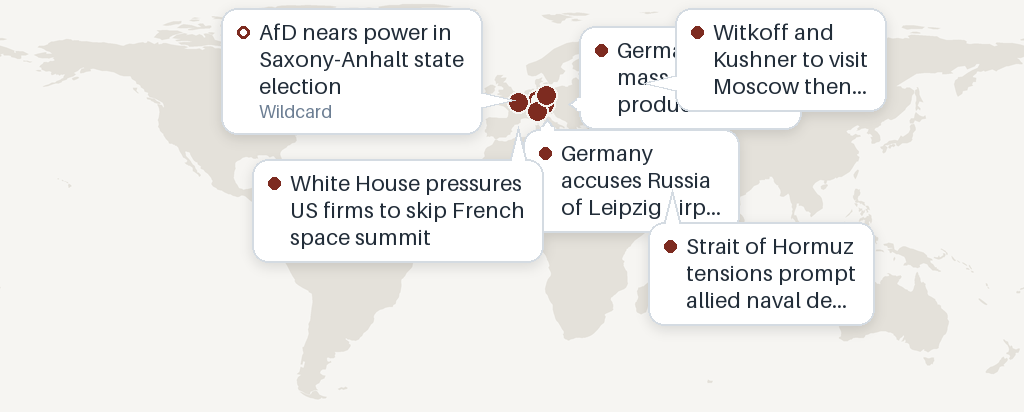
● this issue
Storyline I
Europe's struggle for strategic autonomy
| dormant | background | elevated | hot | critical |
6.8 of 10 · heating ↗
|
This week · Complication Europe is now building real hardware faster than it is building either a unified answer to Russian sabotage or a coherent read on an increasingly unhelpful Washington. The White House is actively pressuring US firms to boycott a French-led space summit, not merely failing to reassure Europe but working against its institutions. Read together with increasing hybrid attacks, and Berlin's diplomatic-only response to the Leipzig drone sabotage (consulate closures, no hardened deterrent posture), the pattern is capability outrunning politics: Germany can now build drones and integrate Israeli LORA missiles on its frigates faster than it can decide how hard to push back against Russian hybrid attacks or reconcile Taurus hesitancy with drone-program speed. The bilateral-pole trend from W34-35 (UK-Germany strike systems, UK-France-Ukraine production) continues unchallenged by any EU institutional response, and the space-summit episode raises the open question of whether US resistance is domain-specific or a broader posture, still unresolved but now evidenced twice in one week. Layer in AfD's poll lead in Saxony-Anhalt, and German-led rearmament, already the arc's most active engine, carries a live domestic fragility risk. |
Germany begins mass production of attack drones for Ukraine
A German-American JV (Auterion) with Ukrainian partner Airlogix began mass-producing two attack drone models near Munich under a roughly €300M German government order, targeting over 5,000 units by mid-2027; the first batch is already built. A second plant is planned in eastern Germany. The drones reportedly use AI targeting resistant to jamming. The night before the opening, two Bulgarian nationals were detained for an arson attempt at a Rohde & Schwarz site, timing that Berlin has not yet linked to the drone program itself.
Framework reads:
- Alliance Politics (Entrapment–Abandonment): This is German production, on German soil, using imported Ukrainian know-how, not Germany licensing capacity into Ukraine as with the earlier Aster 30/Patriot arrangements. That reverses the direction of the 'outsourcing to Ukraine' pattern this arc has been tracking: the junior partner's wartime innovation is now flowing into the patron's industrial base rather than the patron's money flowing into the junior partner's factories. It sits alongside, not inside, EU mechanisms, again. Next: Watch whether Berlin frames the eastern German plant (expected within months) as EU/PESCO-linked or purely bilateral; ~70% probability it stays a national program with no EU co-funding attached, extending the bilateral-pole pattern from W34-35.
- Deterrence Theory: An unattributed arson attempt at a defense-industrial site the night before a major production launch reads as a low-cost, deniable probe designed to test whether Germany will treat industrial sabotage as an act requiring response. It fits the same shape as the Bulgarian-national pattern this arc already flagged as an open question, not yet resolved. Next: Expect at least one more unattributed sabotage or arson attempt near a German defense-industrial site tied to Ukraine drone or missile production within 2-3 months (~40% probability); formal German attribution to a Russian state-linked network within that window stays unlikely (~60% probability it remains unattributed).
- Economic Interdependence & Weaponization: Domestic mass production of AI-guided, EW-resistant drones is a resilience move against both US supply dependence and battlefield jamming, but the JV still runs through a German-American firm, so the 'autonomy' claim is only partial. It complements, rather than replaces, the Patriot-shortage-driven push toward SAMP/T and IRIS-T flagged in W35. Next: Within 6-12 months, expect Germany to announce at least one additional domestic drone JV with a non-US partner explicitly citing supply-chain diversification (~30% probability); absent that, the US-linked dependency in this 'sovereign' program will draw domestic political criticism.
Historical analogues:
- British 'shadow factories' building US-designed aircraft under license in WWII — Allied industrial capacity multiplied by cross-border joint production under wartime urgency — where it breaks: Lend-Lease flowed from hegemon to embattled ally; here the innovator is the smaller, besieged partner (Ukraine) exporting design know-how into the larger patron (Germany), the reverse direction
- Cold War East German Stasi sabotage operations against West German defense targets — Use of small, deniable operatives against defense-industrial sites to signal displeasure without overt state action — where it breaks: Stasi operations were eventually well-documented and attributed; the Bulgarian-national pattern here remains unconfirmed and could stay isolated criminal activity rather than state-directed sabotage
White House pressures US firms to skip French space summit
Defense One reports the White House pushed American aerospace and space firms to skip a summit hosted in France. Industry insiders called the pressure 'unfortunate,' with one policy director warning companies risk becoming a 'prop' used against their own country's commercial interests abroad. No named firms, official justification, or formal policy statement has surfaced yet; this is known only through insider accounts.
Framework reads:
- Economic Interdependence & Weaponization: This is weaponized interdependence turned inward: instead of sanctioning a rival, Washington is leaning on its own private-sector chokepoint, the dominance of US aerospace and space firms, to deny a European-led forum credibility and participation. The likely fear is that a well-attended French summit legitimizes EU space-autonomy initiatives (IRIS2, Ariane successor programs) that compete with US commercial space primacy in launch, satcom, and ISR-adjacent capability. Next: Expect at least one EU official or French ministry statement within 4-8 weeks characterizing this as evidence of US industrial protectionism, and watch for EU counter-signaling on restricting US firm access to IRIS2 or Galileo-adjacent contracts within 3-6 months (~35% probability of a concrete retaliatory gesture in that window).
- Alliance Politics (Entrapment–Abandonment): The insider pushback ('unfortunate,' firms as 'prop') signals that even within Washington's own bureaucracy, this is read as feeding the abandonment narrative already surfaced at the Ankara summit in the consolidated review: allies doubting US commitment is one thing, but active US obstruction of a European institutional effort is a sharper, more corrosive signal than mere absence or hedging. Next: Watch for a French or European Commission statement within 1-2 months explicitly linking this episode to broader concerns about US reliability as a defense-industrial partner, likely cited alongside Patriot shortage and Taurus hesitancy narratives already in the record.
Historical analogues:
- US pressure on allies to exclude Huawei from 5G networks (2019-2020) — Washington using its market and alliance leverage to steer private-sector participation away from a venue or vendor it treats as strategically threatening. — where it breaks: Huawei exclusion targeted an adversary's firm on security grounds; here the target is an ally's own summit, and the excluded parties are American firms, an intra-alliance move rather than containment of a rival power.
- Airbus-Boeing subsidy dispute (1990s-2020s) — Long-running US-EU friction over state backing for national aerospace champions, where industrial policy and strategic rivalry are inseparable. — where it breaks: That dispute was adjudicated through WTO trade law over decades; this is an unlegislated, informal executive pressure campaign with no visible institutional mechanism or paper trail yet.
Also this week:
- Germany accuses Russia of Leipzig sabotage, expels diplomats — Confirms Russian hybrid escalation against German soil but Berlin's response stays diplomatic-only, leaving the 'harder measures' question open even as industrial capability accelerates.
- Israeli LORA missile fired from German frigate — A concrete, if bilateral, step toward non-US procurement diversification that reinforces the pattern of capability-building outside EU institutional channels.
- AfD nears majority in Saxony-Anhalt — Adds a domestic political fragility risk to Germany's rearmament trajectory that is independent of, but could eventually constrain, the Berlin-led capability buildout.
- UK adds boom refueling for Tempest program — A minor but genuine confirmation that UK-led combat-air autonomy (GCAP) keeps advancing on its own bilateral/national track.
What to watch for in the upcoming weeks:
- Any German government or Bundestag statement linking this drone program explicitly to reducing US or Patriot-related dependency (watch within weeks of budget discussion)
- Any further unattributed sabotage or arson incident near German defense-industrial sites tied to Ukraine aid production (watch over 2-3 months)
- Whether Auterion's US ownership triggers any export-control or ITAR-related friction affecting delivery timelines (watch over 6-12 months)
- French government or EU Commission statement addressing the US pressure episode (watch within 1-2 months)
- Any EU proposal to restrict US firm participation in IRIS2, Galileo, or Ariane-successor programs in response (watch within 3-6 months)
- Recurrence of similar US pressure at another EU or UK defense/space forum within 6 months
- Evidence of US firms preemptively declining EU-led forums without direct pressure being reported, once this episode becomes widely known (watch over 3-6 months)
Storyline II
The Ukraine war
| dormant | background | elevated | hot | critical |
6.2 of 10 · steady
|
This week · Complication The localization pattern this arc has tracked since W30 (air defense, then long-range missiles) now extends to mass-produced attack drones, and for the first time the production node sits on German rather than Ukrainian soil, which is why the unresolved Rohde & Schwarz arson attempt and Berlin's An-124 sabotage accusation land as more than background noise: Germany has converted itself from funder into target, and the consulate expulsions and Goethe-Institut closures confirm both capitals now treat that as an open front rather than an isolated incident. In parallel, the Witkoff-Kushner Moscow-then-Kyiv shuttle reactivates a diplomatic track frozen since early 2026, with Kyiv's first-ever inclusion setting a concrete test of whether Ratcliffe's DPRK push and genuine Ukrainian input surface before any Washington-Moscow terms are set. Neither track signals de-escalation on the ground: record Russian strike waves on Kyiv (including a hit on SBU headquarters) and sustained Ukrainian deep strikes into Russian cities show both sides still investing in attrition even as envoys book flights, and a rival-intelligence-unit shootout in Kyiv is a small but real crack in Ukrainian institutional cohesion under that pressure. The two clocks, arms-race and negotiation, are now running side by side rather than one giving way to the other. Building the weapon at home doesn't put it out of reach, and talking doesn't mean either side has stopped fighting for better terms first. |
Germany begins mass production of attack drones for Ukraine
Auterion and Ukrainian partner Airlogix began mass production of two attack drone models (one ranging up to 1,500km) near Munich under a ~€300 million German government order for over 5,000 units, with a second site planned in eastern Germany and completion targeted for mid-2027. Sources say the drones carry AI targeting meant to work through Russian jamming. The night before the plant opened, two Bulgarian nationals were detained for allegedly attempting to set fire to a construction site outside Rohde & Schwarz's offices, an incident of unconfirmed connection to the drone order, arriving alongside Berlin's separate, already-lodged accusation that Moscow orchestrated sabotage against a Ukrainian An-124 cargo plane.
Framework reads:
- Alliance Politics (Entrapment–Abandonment): Germany moving actual production, not just funding or licensing, onto its own territory is a stronger reassurance signal to Kyiv than the Aster/Patriot licensing (W30) or Storm Shadow assembly (W35) tracks, since it embeds Ukraine's war effort physically inside German industry rather than at arm's length. Next: Expect German officials to frame this explicitly as evidence of durable commitment (distinct from the stalled Taurus debate) within 2-4 weeks, and expect at least one coalition voice to raise the exposure this creates for German soil as a target.
- Security Dilemma: Mass, cheap, AI-guided attack drones at 5,000-unit scale mirror the logic already flagged in Russia's Geran launch-rail expansion (W34): both sides are substituting volume and autonomy for the precision-strike model, an arms race in disposable systems rather than exquisite ones. Next: Watch for a comparable German or EU announcement of a second large-volume drone order within 6 months, since the plant's stated cadence toward 5,000 units invites imitation once the Munich line proves out.
- Deterrence Theory: The claimed anti-jamming AI guidance is a denial-based deterrence bet: if it holds up against Russian EW, it degrades one of Moscow's cheapest and most effective countermeasures against Western-supplied drones. Next: Absent confirmed field performance data by mid-2027, treat the anti-jam claim as unproven marketing rather than a demonstrated capability shift; a single credible battlefield report of the system defeating EW would be the first real test.
Historical analogues:
- WWII British shadow factories dispersed inland to avoid Luftwaffe bombing — Concealing exact plant location and name while still producing war material for an active conflict, echoing Auterion's undisclosed site details. — where it breaks: Britain's threat was direct aerial bombardment of a belligerent; Germany faces no comparable air threat, only suspected sabotage and reconnaissance, a much lower-intensity risk environment.
- 1960s Mossad campaign against German scientists working on Egypt's rocket program — Foreign nationals and firms tied to a rival state's weapons buildup becoming targets of covert action on their home soil, similar to the unresolved Rohde & Schwarz arson attempt. — where it breaks: That was a sustained, lethal intimidation campaign with confirmed state sponsorship; the current incident is a single arson attempt with unconfirmed links and no established connection to the drone order itself.
Witkoff and Kushner to visit Moscow then Kyiv on Ukraine talks
Witkoff and Kushner are set to visit Moscow on September 5 and Kyiv on September 6, per Zelenskyy, marking their first-ever stop in the Ukrainian capital after prior contact with Kyiv occurred only in the US, Germany, or France. The trip follows a documented breakdown of US-brokered talks in early 2026 and a late-August visit by CIA Director Ratcliffe to Moscow, where he pressed Russia to cut military and economic support to a third party widely inferred to be North Korea. No agenda or substance has been disclosed beyond a US official's statement that the envoys intend to press for a diplomatic resolution.
Framework reads:
- Alliance Politics (Entrapment–Abandonment): Kyiv's inclusion for the first time is significant less for what it promises than for what it doesn't foreclose: the 2025 pattern was heavy US pressure on Ukraine to accept terms shaped elsewhere, and routing this trip Moscow-first, Kyiv-second keeps that sequencing intact rather than reversing it. Next: Expect Zelenskyy's post-meeting statement within 48 hours of the Kyiv leg to frame the visit as consultation rather than a delivered settlement text; if instead a specific document, map, or framework is reported as handed to Kyiv for response, that confirms continuity with the 2025 imposed-terms pattern rather than a genuine change in approach.
- Economic Interdependence & Weaponization: Ratcliffe's push to cut Russian military and economic support to North Korea is a chokepoint play aimed at a third party, not Russia itself, and this trip is the first venue where that pressure could either surface as a real bargaining chip or quietly disappear. Next: Expect no confirmed Russian concession on DPRK support to emerge from this round, consistent with Ratcliffe's push remaining unconfirmed as of late August; a public Kremlin acknowledgment of even partial drawdown within 30 days of the visit would be the first hard evidence the leverage is working rather than merely being asserted.
- Deterrence Theory: Diplomacy resumed without any accompanying capability signal, no new sanctions, no accelerated interceptor delivery, no visible cost imposed since Russia's missile-volume doubling in W31, so this reads as unleveraged persuasion rather than pressure-backed negotiation. Next: If Washington pairs this shuttle with any explicit statement on continuing or conditioning Ukraine's weapons pipeline within the same window, that would mark a shift toward leverage-backed diplomacy; absence of such a statement through mid-September implies the US is negotiating on trust and access alone.
Historical analogues:
- Dayton Accords, 1995 — External-power shuttle diplomacy produces a settlement negotiated primarily among patrons and adversaries, then presented to the weaker party for signature. — where it breaks: The Bosnian factions were militarily exhausted and dependent on NATO forces on the ground by 1995; Ukraine still retains battlefield agency and an active Western co-production pipeline (Storm Shadow localization, German €12B program), giving Kyiv more room to reject or renegotiate terms than Sarajevo had.
- Paris Peace Talks, 1968-73 — A smaller ally (South Vietnam) was substantively sidelined from great-power negotiations conducted directly between Washington and its adversary's patron, learning terms late. — where it breaks: Ukraine has cultivated independent European channels (UK-France Storm Shadow, German missile program) that South Vietnam never had, meaning even if the US-Russia track dominates, Kyiv has non-US leverage to fall back on.
Also this week:
- Germany accuses Russia of Leipzig sabotage, expels diplomats — Berlin's formal accusation and consulate closures confirm it is hardening its Russia posture just as its own drone plant becomes a plausible sabotage target.
- Russia escalates strikes on Kyiv, hits SBU headquarters — Record-scale strike waves on the capital show no battlefield restraint accompanying the diplomatic reopening.
- Rival Ukrainian intelligence units clash in Kyiv — A public shootout between security services, though quickly condemned by Zelensky, is a visible crack in Kyiv's institutional cohesion during a high-stakes diplomatic week.
- Ukrainian drone strikes hit multiple Russian cities — Continued deep strikes into Russia (Sochi, Yekaterinburg, Belgorod) confirm Ukraine is sustaining rather than pausing its own escalation ahead of the Moscow-Kyiv shuttle.
What to watch for in the upcoming weeks:
- German BfV or federal prosecutor statement attributing the Rohde & Schwarz arson attempt to a state actor (watch weeks to 2 months)
- Confirmation of security posture, fencing, or dedicated policing at the Munich-area plant or the eastern Germany site (1-3 months)
- Kremlin or Russian MFA statement referencing the Auterion-Airlogix plant by name (watch weeks)
- First confirmed combat use or strike attributed to an Auterion-Airlogix-produced drone in Ukraine (realistic window 3-6 months)
- Additional German, French, or Polish government drone co-production orders citing this deal's structure or volume as precedent (3-6 months)
- Any reconnaissance drone or surveillance incident reported near either site (ongoing, watch monthly)
- Official readout or joint statement from either leg of the trip specifying substance discussed (within days of Sept 5-6)
- Zelenskyy's public statement following the Kyiv leg, watched for language distinguishing consultation from a presented framework (within 48 hours of Sept 6)
- Kremlin or MFA statement referencing DPRK support reduction, confirming or denying Ratcliffe's earlier push as a live agenda item (within 2 weeks)
- Any announcement of a follow-on Trump-Putin or Trump-Zelensky summit scheduled as a result of this shuttle (1-2 months)
- Any German or Azerbaijan-track statement addressing coordination or divergence with this US-led shuttle (2-4 weeks)
- Russian military activity (strikes, mobilization signals) in the days immediately following the visit, testing whether diplomacy is paired with or divorced from battlefield behavior (1-3 weeks)
Storyline III
US–Iran confrontation and Middle East realignment
| dormant | background | elevated | hot | critical |
5.9 of 10 · heating ↗
|
This week · Complication This week's dominant mechanism is diffusion rather than escalation: the confrontation's costs are reaching two new constituencies, a non-regional ally (South Korea) pressured toward a Hormuz deployment its own government is downplaying, and American consumers via the diesel shock, while the kinetic core continues on the same trajectory established since W30, another US strike killing civilians at a Kuhestak wedding, Trump calling the war 'small potatoes,' the IAEA still blind on the nuclear program. Nothing this week crosses a new escalation threshold or produces a genuine off-ramp: Israel's Lebanon entrenchment and the dangling prisoner-release gesture remain exactly where W34's open question left them, Jordan keeps absorbing Iranian-linked attacks without retaliating (now explicitly read as deterrence collapse rather than a one-off), and the Houthis edge toward Bab al-Mandab without yet forcing a blockade-enforcement response. Read together, these confirm the storyline's structural stalemate more than they advance it in any single direction, but the addition of an extra-regional ally and a domestic US economic channel means the confrontation's footprint is now wider than its intensity, a war that isn't winning or ending, just spreading its bill. |
Strait of Hormuz tensions prompt allied naval deployments and economic strain
South Korean officials are reportedly seeking parliamentary approval to send a naval logistics ship and P-8A patrol aircraft to the Strait of Hormuz under US pressure, even as the president's office publicly downplays the reports. Simultaneously, analysts document a 'diesel shock' hitting US states from the Hormuz disruption, alongside compounding economic costs across Gulf states and their trading partners with no near-term resolution.
Framework reads:
- Alliance Politics (Entrapment–Abandonment): Seoul's public denial paired with reported private preparation is the classic ally hedge: avoid the domestic political cost of appearing to bandwagon with Trump's war while not risking abandonment by Washington on trade, tariffs, or the US troop presence tied to North Korea deterrence. This is South Korea's version of the entrapment fear that Gulf hosts (Kuwait, W31) and Spain (Moron, W35) have each managed differently, denial of use while capability or commitment proceeds regardless. Next: Expect South Korea to confirm a deployment within 4-6 weeks that is publicly framed as logistics/patrol rather than combat, with officials continuing to deny it constitutes a policy shift even after parliamentary approval is granted.
- Economic Interdependence & Weaponization: The diesel shock converts the Hormuz blockade's costs from an abstract Gulf-side or insurance-premium story (tracked since W30-31) into visible US domestic pain, which is the first channel by which this war could generate direct pressure on Washington's own strike-tempo calculus rather than just Iran's or the Gulf's. Next: Expect at least one state-level (governor or state legislature) statement on diesel/heating-oil prices within 4 weeks from a Northeast or heating-oil-dependent state, distinct from any Gulf Coast producer-state messaging, testing the open question on US domestic political variation.
- Deterrence Theory: Washington pressuring a non-regional ally to contribute naval assets to Hormuz is a capability workaround for the munitions and manpower strain flagged in W32: rather than escalating unilaterally, the US is trying to spread the burden and signal broader coalition backing to Iran without adding its own strike capacity. Next: If South Korea's deployment is confirmed, expect Washington to cite it publicly within days as evidence of 'international resolve,' independent of whether it changes Iran's behavior at Hormuz; no measurable change in Iranian harassment or mining activity is likely to follow within 4 weeks.
Historical analogues:
- South Korea's 2003 Iraq deployment (Zaytun Division) — Seoul again faces a US ally-pressure request tied to alliance maintenance (troop presence, trade) rather than direct South Korean security interest, and again manages it through parliamentary process and public minimization of scope. — where it breaks: 2003 involved ground troops in a stabilization role with sustained domestic protest; a naval logistics ship and patrol aircraft carry far lower troop-casualty risk and thus less likely to generate comparable domestic backlash.
- 1973 oil embargo's uneven US regional impact — A Middle East chokepoint disruption produces geographically uneven domestic fuel pain in the US, generating political pressure disconnected from the war's actual battlefield logic. — where it breaks: 1973 was a deliberate embargo targeting the US directly; the current diesel shock is a byproduct of blockade/strike dynamics with no Iranian intent to specifically punish American consumers.
Also this week:
- Kuhestak wedding strike — A US bomb killed five at an Iranian wedding and Trump dismissed the war as 'small potatoes,' confirming that civilian casualties are now routine and unlikely to force a strike-tempo change.
- Israel's Lebanon entrenchment and dangling prisoner release — Israeli forces took a strategic ridge and cleared Hezbollah tunnels while a prisoner-release gesture remains unlinked to any withdrawal commitment, leaving the security-zone-versus-trilateral-framework question exactly where it stood.
- Jordan's absorbed attacks — Analysts now explicitly frame Amman's non-response as collapsed deterrence rather than restraint, a reinterpretation of an old pattern rather than a new kinetic fact.
- Houthi push toward Bab al-Mandab — Ground gains near the strait sharpen the chokepoint threat flagged since W31 but stop short of the control-loss or blockade-incident threshold that would force a US response.
What to watch for in the upcoming weeks:
- South Korean National Assembly vote or formal approval on the Hormuz deployment, within 2-4 weeks
- Official scale/composition confirmation (naval logistics ship, P-8A aircraft) versus the reported plan, within 2-4 weeks
- Any US statement citing South Korea's deployment as a template for Japan or Australia, within 4-8 weeks
- Congressional hearing or floor statement citing diesel-price impact as a reason to reduce US strike tempo, within 4-8 weeks
- Any tariff, trade, or security-assurance side payment offered by Washington to Seoul tied to the deployment, within 4-6 weeks
Storyline IV
Russia's pursuit of great-power status
| dormant | background | elevated | hot | critical |
5.5 of 10 · heating ↗
|
This week · Complication The week's central move, Germany's formal state attribution of the Leipzig drone attack plus expulsions and a visa-restriction push, was meant to convert months of hybrid-incident ambiguity into a hardened Western deterrence posture, but it landed at the same moment Trump publicly dismissed any Russian intent to test NATO territory, turning the Washington-Berlin divergence first visible after Ratcliffe's Moscow visit (W35) from a one-off into a recurring pattern. That divergence matters because it runs directly alongside the Witkoff-Kushner Moscow-Kyiv shuttle, the latest instalment of the Patel-pardon-Ratcliffe diplomatic track (W30, W33, W35), which continues with no visible linkage to hybrid costs, confirming that Russia's covert and diplomatic fronts keep operating on separate, uncoordinated clocks rather than converging into either coercion or normalization. Berlin's Goethe-Institut closure supplies the first concrete tit-for-tat retaliation, but it's a single symbolic exchange, not the broader escalatory chain the open question anticipated, and Brandenburg's grid sabotage staying unattributed means Germany still hasn't merged its cases into one declared campaign. Naryshkin's Eurasia-conflict warning and the Le Pen flap are noise on top of this, routine signaling and domestic friction that don't move any open question. The net effect: Europe's deterrence signal got louder this week, but Washington didn't amplify it, and Russia's multi-front strategy keeps working precisely because the West's own fronts aren't coordinated either. |
Germany accuses Russia of Leipzig airport drone sabotage, expels diplomats
Germany's interior and foreign ministers formally attributed the August 4-5 explosive-drone attack on a Ukrainian An-124 at Leipzig/Halle Airport to Russian state direction, alleging Moscow supplied equipment and know-how to locally recruited operatives. Berlin closed the Russian consulate and Berlin cultural center and is pushing the EU to tighten tourist visas for Russians; Moscow retaliated by shutting Germany's Goethe-Institut network. The attribution runs alongside a separate, still-unattributed sabotage probe into a Brandenburg power-grid node, and against Trump publicly telling reporters, when asked directly about Leipzig, that Putin has no intention of attacking NATO territory.
Framework reads:
- Deterrence Theory: Germany's formal attribution raises the credibility of future naming-and-shaming, but the punishment attached, consulate and cultural-center closures, is cheap relative to an attempted explosive attack on active Ukraine-bound military logistics. This is denial-by-naming, not punishment with teeth. Next: Absent added costs (new sanctions, asset freezes, expulsion of intelligence-linked staff), expect further hybrid incidents on German infrastructure at a similar tempo over the next 2-3 months, and expect the Brandenburg grid probe to close without a matching formal state attribution in that window (~55% likely it stays ambiguous).
- Alliance Politics (Entrapment–Abandonment): Trump's on-record dismissal of NATO-attack risk, delivered days after being reminded of Leipzig and after the reported Ratcliffe Moscow warning (W35), widens the gap between Berlin's threat framing and Washington's public posture, the divergence this storyline already flagged as an open question. Next: Expect no White House statement reconciling Trump's remarks with the Ratcliffe warning within the next month, and expect Germany's EU visa-restriction push to stall short of a Council vote by end of October, on the same Warsaw-Berlin fault line already visible over the Zhuravlev case.
- Power Transition / Thucydides Trap: Consistent with the low-cost, multi-front pattern already logged across the Kazakhstan strain, the Austria back-channel and the Kuril visit, Moscow is contesting the Western order through deniable disruption rather than the higher-risk military test Ratcliffe reportedly warned against. Next: Expect Russian state media to deny involvement or frame the accusation as Western fabrication rather than adjust Moscow's Ukraine negotiating posture, over the following weeks.
Historical analogues:
- 2018 Skripal poisoning and coordinated NATO diplomatic expulsions — A hybrid attack on Western soil produces formal state attribution followed by diplomatic expulsions as the visible punishment. — where it breaks: Skripal triggered a genuinely bloc-wide response, over 150 diplomats expelled across 25+ countries; here Germany is acting largely alone, with the visa push unadopted and Poland already at odds with Berlin over a related sabotage case.
- Cold War-era tit-for-tat cultural-exchange freezes — Reciprocal closure of cultural and consular institutions as the cheapest available signaling tool during a diplomatic standoff. — where it breaks: Cold War exchanges operated inside a stable bipolar deterrent structure with clear escalation ceilings; the trigger here is an attempted bombing tied to a live war, a materially higher-stakes provocation than Cold War cultural disputes.
Also this week:
- Witkoff and Kushner to visit Moscow then Kyiv — The Washington-Moscow diplomatic track continues on its own schedule, uncoupled from Germany's hybrid-sabotage attribution and expulsions the same week.
- Naryshkin warns of Eurasia-wide conflict risk — Routine nuclear-adjacent rhetoric from Russia's spy chief that restates established deterrence messaging without new capability or policy content.
- National Rally's Ukraine stance draws fire — Domestic French criticism of Le Pen's ambiguous Ukraine position reflects ongoing intra-EU friction over Russia policy but adds no new behavioral data point.
What to watch for in the upcoming weeks:
- EU Council or Commission formally proposing or adopting bloc-wide Russian tourist visa restrictions (within 4-8 weeks)
- Poland or Baltic states publicly backing Germany's visa push despite Zhuravlev-case friction (within weeks)
- Formal attribution statement or charging document on the Brandenburg grid sabotage naming a state actor (within 2-3 months)
- Additional Russian retaliatory closures beyond Goethe-Institut, consular or academic (within following weeks)
- White House or State Department statement reconciling Trump's remarks with the Ratcliffe NATO-warning reporting (within 2-4 weeks)
- Published terms or leaks from the Witkoff/Kushner Moscow-Kyiv proposal addressing sanctions or hybrid attacks (within weeks)
Storyline V
US–China power transition
| dormant | background | elevated | hot | critical |
1.8 of 10 · cooling ↘
No significant movement this week.
|
Wildcard AfD nears power in Saxony-Anhalt state election — Polls ahead of the September 6-7 vote in Saxony-Anhalt show the far-right Alternative for Germany (AfD) potentially winning an outright majority, which would make it the first far-right party to govern a German state since World War Two. Coverage details the party's ties to extremist networks despite efforts to soften its image, and previews similar contests in two other eastern German states this September that test the postwar taboo on far-right rule and Chancellor Merz's political strategy. (A far-right party crossing the threshold from opposition to governing majority in a major EU economy for the first time since 1945 is a genuine structural break in postwar European politics, not merely a continuation of far-right electoral gains. It would seed multiple tracking storylines (EU institutional response, NATO cohesion, German coalition dynamics) and merit historical scrutiny as a potential inflection point in European stability.) — possible new storyline? |
|
Idea or discussion? Hit reply. irlens.apps.pompadour.ventures |