Weekly geopolitical storylines
IR Lens
Week 2026-W34 · 23 August 2026
|
Editor's note Please keep in mind this is still early beta & an experiment. I'm working on improvements inside and out, so expect changes from week to week. Among other things, I've added a archive this week, check it on the website. Ideas for improvement(s)? Reply to this email! |
Why does a week with a live war in the Gulf keep producing news out of Berlin? Because Washington's attention & support is the scarcest resource in the geopolitical system right now, and every actor in this story is spending accordingly.
Russia hardens drone infrastructure and runs a covert cell on German soil while its diplomats stay silent. Poland picks a fight with Germany over Nord Stream. Germany, meanwhile, answers none of it through NATO or Brussels but through a bilateral costed program with London. That's the mechanism: American distraction is licensing unilateral moves everywhere else.
What matters most is whether the Bundestag actually funds that €12 billion strike arsenal. Rhetoric about hedging against US extended deterrence becomes real capability only with that vote, and I'd put the odds of approval this cycle at roughly three in five. Watch the budget line, not the press release.
|
In this issue 01 US–Iran confrontation and Middle East realignment — Trump mixes Hormuz sovereignty bluster with economic-warfare threats while Iran claims it's negotiating from strength, and the war's economic fallout, UAE's Iran embargo, rerouted flights, strained US munitions and Golden Dome funding, keeps compounding regardless. 02 Russia's pursuit of great-power status — Poland's PM told Germany to drop the Nord Stream sabotage prosecution, arguing the pipeline's builders, not its destroyers, deserve blame. German prosecutors say a forest gun cache found last year was meant for a Russian-linked assassination plot, and they want the suspect extradited from Romania. 03 The Ukraine war — Germany is committing ~€12 billion to build its own long-range strike arsenal, capable of hitting Russian targets far behind the front, ending decades of German restraint on offensive weapons. Satellite images show Russia building permanent, expanding drone-launch bases, some already hitting Ukraine and now able to reach NATO territory too. 04 Europe's struggle for strategic autonomy — Germany's defense ministry is budgeting nearly €12 billion for long-range strike weapons to hit Russian targets deep behind the front, explicitly to answer aggression without going nuclear. 05 US–China power transition — no significant movement. |
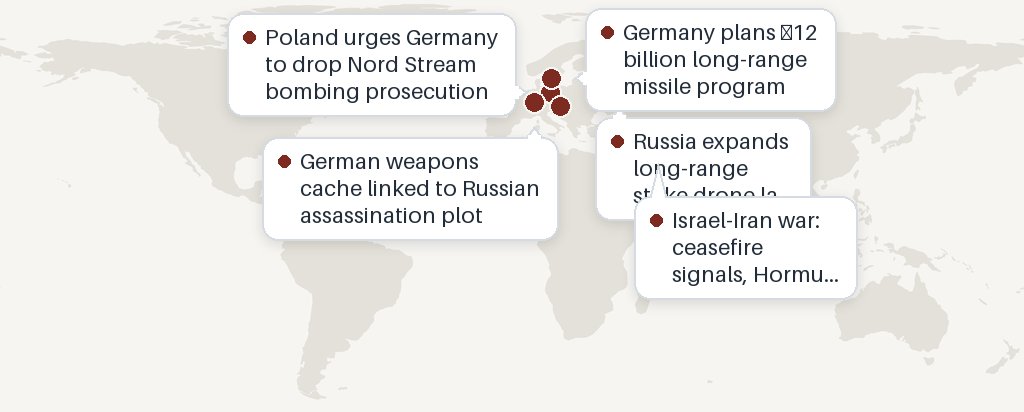
● this issue
Storyline I
US–Iran confrontation and Middle East realignment
| dormant | background | elevated | hot | critical |
6.1 of 10 · cooling ↘
| TL;DR — Trump mixes Hormuz sovereignty bluster with economic-warfare threats while Iran claims it's negotiating from strength, and the war's economic fallout, UAE's Iran embargo, rerouted flights, strained US munitions and Golden Dome funding, keeps compounding regardless. |
Israel-Iran war: ceasefire signals, Hormuz rhetoric and economic fallout
Trump alternated between threatening Iran with 'economic warfare' and calling the Strait of Hormuz 'American territory,' while the US naval blockade of Iranian shipping continues without formal legal follow-through on either claim. Pezeshkian said Iran is ready to end the war from a position of strength, but talks remain stalled. Meanwhile the conflict's economic fallout has hardened: the UAE imposed a total transaction embargo on Iran, long-haul air traffic is shifting from Gulf hubs to Seoul and other Asian hubs, and US officials confirmed the war is straining munitions stockpiles and complicating Golden Dome funding.
Framework reads:
- Deterrence Theory: Trump's simultaneous 'economic warfare' threat and Hormuz sovereignty claim are cost-free rhetorical escalations layered on a punishment campaign already flagged (W32) as capability-constrained. Pezeshkian's public 'position of strength' statement is Iran explicitly, not just tacitly, rejecting the coercive premise, converting the inferred 'outlast Trump' strategy from W31-32 into declared policy. Next: Expect no US legal or military action operationalizing either the Hormuz claim or 'economic warfare' rhetoric within 4 weeks; if none appears, credibility erosion documented since W33 deepens rather than reverses.
- Economic Interdependence & Weaponization: The UAE's total embargo, the Seoul-bound diversion of long-haul air traffic, and the Pentagon's admitted munitions strain show the war's economic costs are no longer episodic (insurance spikes, one-off tanker incidents) but structural, hitting the US defense-industrial base as hard as Gulf commerce. Next: Within 2 months, expect at least one additional Gulf-linked firm or state (insurer, airline, or bank) to publicly announce new Iran-transaction restrictions independent of formal sanctions, extending the UAE pattern rather than reversing it.
- Alliance Politics (Entrapment–Abandonment): UAE's total embargo is a clarifying choice, not ambiguous hedging: Abu Dhabi is picking the Washington-aligned lane while Oman continues shuttle diplomacy (W33) and the Mecca-pact states (W32) hedge via indigenous defense architecture instead. Gulf responses are visibly bifurcating rather than converging. Next: Qatar and Oman will likely preserve working channels with Tehran rather than match UAE's embargo within the next 4-6 weeks (~65%), given their standing roles as mediators; a matching move by either would be a stronger signal than UAE's alone.
Historical analogues:
- The Tanker War (1984-88) — Gulf shipping disruption and reflagging produced chronic insurance and rerouting costs that outlasted any single military engagement, without either side achieving a decisive result. — where it breaks: That war lacked a second chokepoint (Bab al-Mandeb) and a parallel aviation-hub reordering; today's disruption is broader and touching sectors (air travel, missile-defense budgets) the Tanker War never reached.
- Paris Peace Talks framing, Vietnam War (1968-73) — Hanoi negotiated while publicly insisting it held the stronger hand, refusing language that read as capitulation even amid battlefield stalemate, echoing Pezeshkian's 'position of strength' framing now. — where it breaks: North Vietnam had sanctuary and patron backing (USSR, China) insulating it from the kind of visible, immediate economic squeeze (UAE embargo, aviation flight) Iran faces in real time.
Storyline: advance — This entry advances the storyline's economic-fallout track from rhetoric and forecast (W31's chokepoint proliferation, W32's munitions-exhaustion finding) into concrete, dated data points: a Gulf state's total financial severance, a measurable Gulf-to-Asia aviation shift, and an on-record congressional acknowledgment that Iran war costs threaten Golden Dome. It also converts the inferred 'Iran plans to outlast Trump' reading (W31-32) into an explicit Iranian public claim of negotiating strength, sharpening rather than merely confirming that thread. Trump's Hormuz and 'economic warfare' rhetoric continues the pattern flagged in W33 of maximal cost-free declaratory statements substituting for capability that W32 already showed is strained.
Watch for:
- UAE-Iran trade and financial-flow data confirming the embargo's actual bite versus informal workarounds (2-4 weeks)
- Any Iranian cyber, proxy, or maritime action targeting UAE-linked assets in retaliation for the embargo (weeks)
- Qatari or Omani statements explicitly declining to follow UAE's embargo, preserving mediator channels (2-4 weeks)
- FY2027 defense appropriations markup language explicitly citing Iran war costs against Golden Dome funding (1-2 months)
- Treasury/OFAC action specifically tied to Trump's 'economic warfare' threat, distinguishing it from the unactioned Hormuz claim (days to weeks)
- Airline capacity commitments (new routes, aircraft reallocation) to Seoul or other Asian hubs signaling durability beyond the war (1-3 months)
- IRGC or hardline Iranian media response to Pezeshkian's 'position of strength' remarks, endorsing or contradicting it (days)
Storyline II
Russia's pursuit of great-power status
| dormant | background | elevated | hot | critical |
5.6 of 10 · heating ↗
| TL;DR — Poland's PM told Germany to drop the Nord Stream sabotage prosecution, arguing the pipeline's builders, not its destroyers, deserve blame. German prosecutors say a forest gun cache found last year was meant for a Russian-linked assassination plot, and they want the suspect extradited from Romania. |
Poland urges Germany to drop Nord Stream bombing prosecution
Tusk publicly urged Germany to abandon its case against Nord Stream bombing suspects, following the Croatian detention of Ukrainian citizen Volodymyr Zhuravlev under a German warrant. Tusk framed the pipeline itself, and Germany's earlier embrace of Russian gas dependence, as the real wrongdoing. The Kremlin, via Peskov, called this an endorsement of terrorist sabotage and expressed 'astonishment' at Tusk's position.
Framework reads:
- Alliance Politics (Entrapment–Abandonment): This is a client state (Poland) publicly diverging from a patron-bloc partner's (Germany's) prosecutorial stance, effectively legitimizing an act that damaged German-Russian infrastructure while protecting a Ukraine-linked suspect. It exposes that NATO/EU cohesion on Nord Stream was always aspirational rather than settled, echoing the Polish court's 2025 extradition refusal already noted as a precedent-setting friction point. Next: Expect at least one Baltic state (Lithuania, Latvia, or Estonia) to publicly echo Tusk's framing within 4-6 weeks, while France or the Nordic states stay silent rather than align with either Warsaw or Berlin.
- Power Transition / Thucydides Trap: Russia has no capability stake here but a large narrative one: Peskov's statement works to reframe the bombing as an attack on 'Europe's critical infrastructure' rather than a justified response to coercive energy dependence, positioning Moscow as the wronged party in the court of European opinion. Next: Russian state media will amplify Tusk's remarks as evidence of Western hypocrisy and NATO disunity over the following 1-2 weeks, without any accompanying shift in Russia's own sanctions or Ukraine negotiating posture.
Historical analogues:
- Israel's 1976 Entebbe raid and Uganda's sovereignty complaint — A third state's sovereignty or legal process is publicly dismissed as illegitimate because the underlying target was deemed to deserve destruction, regardless of the venue's jurisdiction. — where it breaks: Entebbe involved no NATO ally accusing another of misplaced prosecution; here the dispute is intra-alliance, not between an alliance and an outside actor.
- West Germany's Ostpolitik-era energy dependence debates (1970s) — Poland's long-standing objection to Nord Stream mirrors earlier Central European warnings against West German-Soviet gas ties as strategically naive. — where it breaks: In the 1970s the dependence was tolerated for decades without sabotage; here the pipeline was destroyed within years, compressing the vindication timeline dramatically.
Storyline: complication — This adds a fifth, distinct thread to the multi-front picture built across W30-W33: an intra-Western legal and narrative fracture over how to characterize an act of sabotage against Russian-linked infrastructure, rather than a Russia-West or Russia-China axis move. It sharpens, rather than resolves, the open question on whether EU states will align with Tusk's framing, since this is the clearest public bloc-split statement yet from a sitting head of government. Combined with the Austria back-channel (W32) and Kazakhstan/Armenia strain (W31), the pattern of simultaneous, uncoordinated fault lines across Russia's Western relationships continues, though this one runs entirely among Western allies with Moscow merely commenting from the sidelines.
Watch for:
- German prosecutorial or government response to Tusk's statement, defending or reconsidering the case (within 1-2 weeks)
- Croatian extradition decision on Zhuravlev, granted or refused, and any political commentary accompanying it (within 4-8 weeks)
- Statements from Baltic states, France, or Ukraine's government explicitly aligning with or distancing from Tusk's framing (within 4-6 weeks)
- Russian state media volume and framing of the Tusk-Peskov exchange over the following days
- Whether the European Commission or NATO issues any statement on the case to manage the visible Polish-German divergence (within weeks)
German weapons cache linked to Russian assassination plot
German federal prosecutors confirmed that a weapons cache discovered in a forest near Berlin last year was intended for a politically motivated attack, with intelligence pointing to Russian direction. No individual or state actor has been officially named. Authorities are seeking extradition of a suspect currently in Romania, and commentary is already framing this alongside the Leipzig drone incident as part of a wider gray-zone campaign.
Framework reads:
- Deterrence Theory: Germany's careful non-attribution, even while briefing the Russia link to media, is a punishment-deterrence signal without the credibility of an actual named culprit or sanction attached. That gap is the whole story: Berlin wants to warn Moscow off without committing to a diplomatic confrontation it may not be ready to escalate. Next: Absent a formal state attribution within 2-3 months, expect further gray-zone incidents in Germany (sabotage, arson, cyber) at a similar or higher tempo, since the deterrent signal here carries no attached cost.
- Alliance Politics (Entrapment–Abandonment): A plot targeting political figures on German soil, if formally tied to Moscow, tests whether Berlin will lead a coordinated EU/NATO hybrid-response posture or handle it as a bilateral judicial matter, echoing the still-open question about the Zhuravlev case and Polish pressure. Next: Expect Baltic states to publicly cite this case within weeks as evidence for a pattern, while France and Ukraine's government stay comparatively quiet, reflecting the bloc-alignment split already flagged for the Zhuravlev case.
- Power Transition / Thucydides Trap: This is a low-cost, deniable probe consistent with a dissatisfied power testing how much internal disruption Western societies will absorb before organizing a response, not a capability-parity signal in the traditional sense. Next: Expect Russian state media to either ignore the story or frame it as a Western fabrication, rather than engaging substantively, within days of Western coverage peaking.
Historical analogues:
- Bulgaria arms-depot sabotage attributed to GRU Unit 29155 (2010s) — Same actor class (Russian military intelligence), same method (deniable domestic infrastructure disruption), same reliance on regional cutouts to obscure the chain. — where it breaks: That campaign targeted materiel destined for Ukraine and other frontline states; this one allegedly targeted people, a substantially higher escalation threshold.
- 1978 Bulgarian assassination of Georgi Markov in London (umbrella poisoning) — State-directed assassination plot on NATO/Western soil against a political target, using deniable tradecraft. — where it breaks: Markov's killing was Cold War bloc-on-defector violence with clear ideological motive; here the intended target and motive remain unconfirmed, and the plot was reportedly interdicted before execution.
Storyline: advance — This adds a fifth active thread to the multi-front picture built across W30-W33: Patel-Moscow diplomacy, Kazakhstan/Armenia strain, the Austria back-channel, the pardon, and the Kuril-Pacific axis. Unlike those, this is squarely a hybrid-operations data point on German soil, sharpening the open question about whether the Leipzig drone case and this cache get formally linked into a recognized pattern. The non-attribution stance mirrors the caution seen around the Austria talks and the pardon, reinforcing the reading that Moscow's covert and diplomatic tracks are running in parallel without visible coordination, exactly the compartmentalization question this storyline has been tracking since W32.
Watch for:
- German federal prosecutors' formal charging document naming a state actor or GRU/SVR unit (likely within 2-4 months)
- Romania's extradition court ruling on the suspect (expect initial hearing within weeks, final ruling in months)
- Whether German officials or EU statements explicitly link this case to the Leipzig drone incident as a single campaign (within weeks)
- Kremlin or Russian state media response to the allegations (within days of peak Western coverage)
- Any NATO or EU joint statement on hybrid-threat coordination referencing this case specifically (within 1-2 months)
- Whether Baltic states, France, or Ukraine issue public statements aligning with Germany's framing (within weeks)
Storyline III
The Ukraine war
| dormant | background | elevated | hot | critical |
4.8 of 10 · heating ↗
| TL;DR — Germany is committing ~€12 billion to build its own long-range strike arsenal, capable of hitting Russian targets far behind the front, ending decades of German restraint on offensive weapons. Satellite images show Russia building permanent, expanding drone-launch bases, some already hitting Ukraine and now able to reach NATO territory too. |
Germany plans €12 billion long-range missile program
Internal German defense ministry documents show Berlin plans nearly €12 billion for a four-phase long-range weapons program, with initial systems fielded as early as 2027 and the most advanced, jointly developed with the UK, arriving mid-next-decade. The stated aim is to let German forces strike command centers, airfields, and supply hubs hundreds to thousands of kilometers into enemy territory, keeping response options 'below the nuclear threshold.' The funding has been submitted in budget planning but not yet approved by the Bundestag.
Framework reads:
- Deterrence Theory: This is a denial-and-punishment hybrid: Germany is building capability to hold Russian rear-area assets at risk conventionally, closing a gap in NATO's sub-nuclear deterrent ladder that has existed since the Taurus-to-Ukraine debate exposed Berlin's reluctance to field, let alone transfer, such systems. Next: Expect German officials or NATO statements within 1-2 months to explicitly frame the program as filling an alliance-wide conventional deep-strike gap, not a Germany-only deterrent, as a credibility-building signal to Moscow and to reassure eastern allies.
- Security Dilemma: Berlin frames this as defensive deterrence, but a historically restrained power building thousand-kilometer strike range is exactly the kind of capability that is hard for an adversary to distinguish from offensive war planning, especially paired with UK co-production. Next: Expect a Kremlin or MFA statement within 2-4 weeks citing the program as evidence of NATO's offensive rearmament, likely referencing it in the context of Russia's own missile-force modernization rather than treating it as purely defensive. Arms race escalation.
- Alliance Politics (Entrapment–Abandonment): A German sovereign strike program, jointly built with the UK for its most advanced tier, signals Berlin no longer wants to depend solely on US extended deterrence or ad hoc Taurus-style debates, reducing abandonment risk but raising the profile of European strategic autonomy within NATO. Next: Expect France and/or Poland to announce a competing or complementary sovereign long-range strike initiative within 6 months, driven by reluctance to let Germany set the ceiling on European strike capability alone.
Historical analogues:
- NATO's 1979 dual-track Pershing II/GLCM deployment — European long-range missile buildup framed as closing a deterrence gap against Moscow while diplomacy continues in parallel — where it breaks: Pershing II was a multilateral NATO deployment of US missiles on allied soil under a dual-track diplomacy-and-deployment logic; this is a unilateral German program funding its own arsenal, with no equivalent public arms-control track attached.
- Germany's 2024 Taurus-to-Ukraine refusal — Same weapon class, same escalation anxieties about striking deep into Russian-controlled or Russian territory — where it breaks: That was about transferring strike capability to a belligerent; this is Germany arming itself, which removes the third-party escalation logic that made Scholz's government balk in 2024.
Storyline: advance — This turns the open question flagged at W30, whether Germany's parallel pursuit of long-range strike undermines or leverages the Azerbaijan back-channel, from speculative into concrete: Berlin is now on record with a budget figure, a phased timeline, and a UK co-production partner. It also complicates the security-dilemma dynamic already running in this arc since W31, where Russia's missile-volume doubling was read as an unanswered escalation; Germany's program is the first visible Western capability response in this storyline that mirrors rather than merely absorbs Russian pressure. Whether Moscow treats this as proof the Azerbaijan track is cover for German rearmament, or as a bargaining chip Berlin will trade away in negotiations, is now the live question rather than a hypothetical one.
Watch for:
- Bundestag defense committee first reading or vote on the €12B line item (watch next 3-6 months)
- Kremlin, MFA, or Lavrov statement referencing the program, especially any linkage to the Azerbaijan talks (weeks)
- France or Poland announcing a sovereign or joint long-range strike program (3-6 months)
- Naming of the specific UK-German joint system and its stated range/warhead class (weeks to a few months)
- Any German coalition partner (Greens, SPD left wing) publicly contesting the program's cost or 'below nuclear threshold' framing (weeks)
- Russian force-posture statements or exercises explicitly citing German rearmament as justification (1-2 months)
Russia expands long-range strike drone launch infrastructure
Commercial satellite imagery and a Telegraph/DroneSec investigation identified at least 10 Russian sites with newly built or expanded dedicated launch infrastructure for long-range one-way attack drones, totaling 59 rails, roughly 20 of them lengthened to accommodate larger Geran variants. Open-source tracking confirms seven of the ten sites have already been used against Ukraine. The remaining sites are positioned such that they extend Geran range toward NATO's eastern flank, not just Ukrainian territory.
Framework reads:
- Security Dilemma: Fixed, extended-rail infrastructure is a sunk-cost signal, not an improvised wartime fix. That kind of permanent buildout is what a state does when it expects to sustain or grow strike volume for years, which reframes the W31 missile-doubling episode as part of a longer capability curve rather than a one-off spike. Next: Expect Ukraine to prioritize strikes on the seven already-confirmed active sites within the next 4-6 weeks; if those sites remain operational and additional ones come online instead, that confirms interdiction is losing the race against fixed-infrastructure buildout.
- Deterrence Theory: Extending drone range toward NATO territory tests extended deterrence before any actual strike occurs, the same probing logic already seen in prior European drone-incursion episodes. Capability is now demonstrably in place; credibility of a NATO response is untested because no launch against alliance territory has happened yet. Next: Expect at least one Geran or decoy-drone incursion into Polish, Romanian, or Baltic airspace plausibly linked to these new sites within 2-3 months, likely prompting a formal Article 4 consultation request rather than kinetic response.
- Alliance Politics (Entrapment–Abandonment): Public satellite confirmation of NATO-reaching launch sites shifts this from an abstract risk to a named, mapped threat, which sharpens frontline states' abandonment fears more than Kyiv's entrapment concerns. Next: Expect Poland, Romania, or the Baltic states to explicitly cite this reporting in requests for additional air-policing assets or Patriot/interceptor reinforcement within 4-8 weeks, distinct from any general NATO reassurance statement.
Historical analogues:
- Iraqi Scud dispersal in the 1991 Gulf War — Mobile/dispersed launch infrastructure built specifically to complicate detection and interdiction while extending reach beyond the immediate battlefield. — where it breaks: Scuds were mobile to evade strikes; Geran rails are fixed and now mapped, meaning Russia is trading concealment for throughput, a different risk calculus.
- German V-1 launch ramp construction in occupied France, 1943-44 — Permanent, purpose-built launch infrastructure signaling intent to sustain a long-range strike campaign against a wider target set than the immediate front. — where it breaks: Allied bombing campaigns against V-1 sites achieved only partial delay; here Ukraine's deep-strike capacity against fixed rail infrastructure is far more constrained by distance and air defenses guarding Russian territory.
Storyline: advance — This gives the first concrete infrastructure-level evidence for the open question flagged after W31's missile-volume doubling: whether Russia's strike mix is a temporary hedge or a structural shift toward drones. Permanent, expanding launch rails sized for larger Geran variants argue for structural shift, since dispersing fixed sites and lengthening rails is not something built for a short-term substitution. It also converts the previously abstract NATO-range risk into a mapped, named set of ten sites, which raises the bar for what counts as alliance reassurance versus mere rhetoric going forward.
Watch for:
- Ukrainian strike reporting or satellite confirmation of damage at any of the seven already-active sites (next 4-6 weeks)
- New satellite imagery showing further site construction or rail extension beyond the ten identified (ongoing, watch monthly)
- Any Geran/decoy drone incursion or forced-landing incident in Polish, Romanian, or Baltic airspace traceable to extended range (2-3 months)
- NATO statements or Article 4 consultation requests explicitly citing this infrastructure reporting (4-8 weeks)
- Confirmed range/payload specifications of the larger Geran variant tied to the extended rails (weeks to 2 months)
- Frontline state requests for additional Patriot/interceptor assets citing this specific threat (1-2 months)
Storyline IV
Europe's struggle for strategic autonomy
| dormant | background | elevated | hot | critical |
4.7 of 10 · heating ↗
| TL;DR — Germany's defense ministry is budgeting nearly €12 billion for long-range strike weapons to hit Russian targets deep behind the front, explicitly to answer aggression without going nuclear. |
Germany plans €12 billion long-range missile program
Internal German defense ministry documents, seen by Politico, put the cost of a new long-range strike arsenal at almost €12 billion across four program tranches, with initial weapons fielded as early as 2026 and the most advanced systems co-developed with the UK for the mid-2030s. The stated purpose is to let German forces strike command centers, airfields, and supply hubs deep in an adversary's rear while staying below the nuclear threshold. The funding has not yet been approved by the Bundestag.
Framework reads:
- Deterrence Theory: The 'below the nuclear threshold' language is the tell: Berlin is building a conventional deep-strike layer specifically because it doubts NATO's (and its own) response options between a shrug and a nuclear signal are credible against Russia today. That is deterrence-by-denial (threaten the launchers and logistics before they're used) blended with a punishment logic aimed at rear-area targets Moscow assumed were sanctuaries. Next: Expect a Russian MFA or MOD statement treating this as comparable to the 2024 US Typhon deployment, invoking INF-era grievances, within weeks of the Bundestag's first substantive budget reading (~55% probability of rhetorical protest, ~15% of a matching deployment threat, within 2 months).
- Alliance Politics (Entrapment–Abandonment): This is Germany hedging against abandonment risk (doubt that US extended deterrence, nuclear or conventional, will hold) while carefully labeling the program a 'NATO priority' to avoid the appearance of going it alone. The UK-Germany joint track for the advanced systems is the more structurally interesting piece: it builds a bilateral defense-industrial pole for exactly the capability tier (long-range precision strike) that EU mechanisms like PESCO have struggled to deliver. Next: Watch for a formal UK-Germany MoU or treaty annex on the joint advanced-system track within 6-12 months; if it appears without French or EU-level co-funding attached, that confirms the bilateral-pole reading over the PESCO/EDF-complement reading.
Historical analogues:
- NATO's 1979 dual-track decision and Pershing II deployment — A European ally hosts/builds a new strike capability specifically to close a perceived gap in NATO's response ladder after doubting the credibility of the existing deterrent posture, triggering Soviet protest. — where it breaks: Pershing II was a US-owned nuclear system under NATO custody arrangements; this is a German-owned, German-funded conventional system explicitly framed to avoid nuclear escalation, a different sovereignty and escalation profile entirely.
- Gaullist France's Force de Frappe — A capability built as insurance against doubts that a patron's deterrent umbrella will actually be extended in a crisis. — where it breaks: France sought nuclear independence to escape reliance on the US umbrella altogether; Germany is deliberately staying conventional and non-nuclear, seeking to reinforce NATO's ladder rather than exit it.
Storyline: advance — The consolidated W29-W30 review flagged Germany's strike buildout as an open question about whether it is genuine hedging against doubts over US extended deterrence, still unconfirmed by any budgetary commitment. This entry supplies that commitment: a costed, four-part program with an explicit 'below the nuclear threshold' rationale, moving the question from rhetorical to documented, even though Bundestag approval is still pending. It also sharpens the UK-Germany bilateral track flagged in the same review, since the advanced-system tranche is co-developed with London on a mid-2030s timeline outside any visible EU-level funding mechanism, reinforcing the pattern of capability-building happening through bilateral or national channels rather than EU institutions.
Watch for:
- Bundestag budget committee action on the €12B tranche during the FY2026 cycle (expected within months)
- Kremlin or Russian MOD statement referencing the program, likely within 2 months of major German parliamentary debate
- Any formal UK-Germany MoU, treaty annex, or contract announcement on the joint advanced-strike system (watch over 6-12 months)
- Whether France seeks inclusion in, or is excluded from, the UK-Germany advanced-system track (next 3-6 months)
- Whether the four program tranches survive intact or face delay/cuts as they compete with conventional Zeitenwende rearmament costs in budget markup
Storyline V
US–China power transition
| dormant | background | elevated | hot | critical |
1.8 of 10 · cooling ↘
No significant movement this week.
|
Wildcard CENTCOM uses AI targeting system in Operation Epic Fury — U.S. Central Command employed the Claude AI model via Palantir's Maven Smart System to generate and prioritize roughly 1,000 targets within the first 24 hours of a campaign dubbed Operation Epic Fury, marking a significant expansion of AI's role in American warfighting. (This represents a threshold crossing in AI integration into kinetic warfare (1,000 targets in 24 hours via Claude/Palantir, not simulation), materializing a long-theorized vulnerability—algorithmic targeting at scale—that could seed major storylines around AI escalation dynamics, adversary counter-responses, and structural instability in human-in-the-loop constraints, making it a genuine inflection point worth historian attention if the pattern persists.) — possible new storyline? |
|
Idea or discussion? Hit reply. irlens.apps.pompadour.ventures |