Weekly geopolitical storylines
IR Lens
Week 2026-W35 · 30 August 2026
|
Editor's note Please keep in mind this is still early beta. I'm working on improvements inside and out, so expect changes from week to week. One theme this week was readability - the digest should be easier to scan and read. I've also noticed that different storylines have overlapping stories. Ideas for further improvement(s)? Reply to this email. |
A big week in Europe. London, under its new prime minister Andy Burham, licensed Storm Shadow assembly to Kyiv, while NATO's own Patriot stocks in Europe went "beyond critical" from Middle East diversion. Whether the interceptor shortfall pushes EU interceptor production onto the fast track, remains to be seen.
Meanwhile, the CIA director made a surprise visit to Moscow. The reason is still not clear, although there are various rumours going around.
Read on!
|
In this issue 01 Europe's struggle for strategic autonomy — Britain's new PM made his first foreign trip about giving Ukraine the tech to build its own Storm Shadow missiles, stepping into the void Merz left by skipping Kyiv. US officials admit Europe barely has enough Patriot interceptors to stop one Russian missile, because Middle East wars drained the stockpile meant for NATO. 02 The Ukraine war — New UK PM Andy Burnham's first foreign trip unlocks British tech for Ukraine to build its own Storm Shadow cruise missiles, publicly outflanking Germany's stalled Taurus promise. US and NATO officials admit American Patriot stocks in Europe are so depleted they could barely stop one Russian missile, let alone a real attack, largely because the Middle East wars drained the supply. 03 Russia's pursuit of great-power status — The CIA director secretly flew to Moscow, apparently to warn Putin against testing NATO or reaching for tactical nukes, which tells you Washington now sees that risk as real. 04 US–Iran confrontation and Middle East realignment — The Pentagon is adding B-52 parking at Moron, Spain, even though Madrid already refused to let the base be used for Iran strikes, showing infrastructure expansion proceeding independent of host-nation political limits. 05 US–China power transition — no significant movement. |
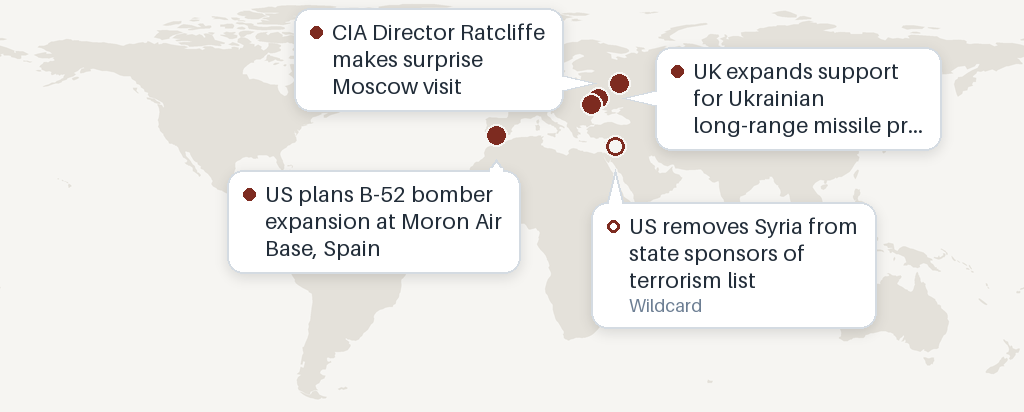
● this issue
Storyline I
Europe's struggle for strategic autonomy
| dormant | background | elevated | hot | critical |
6.2 of 10 · heating ↗
| TL;DR — Britain's new PM made his first foreign trip about giving Ukraine the tech to build its own Storm Shadow missiles, stepping into the void Merz left by skipping Kyiv. US officials admit Europe barely has enough Patriot interceptors to stop one Russian missile, because Middle East wars drained the stockpile meant for NATO. |
UK expands support for Ukrainian long-range missile production
New UK PM Andy Burnham traveled to Kyiv as his first overseas trip, announcing that London will let MBDA declassify British-made Storm Shadow/SCALP component data so Ukraine (working with France) can locally assemble the cruise missile. The move responds to depleted Western stockpiles and builds on Ukraine's growing indigenous defense industry. German Chancellor Merz, by contrast, skipped the Kyiv independence day events for a domestic crisis, having already walked back his opposition-era pledge on Taurus missiles.
Framework reads:
- Alliance Politics (Entrapment–Abandonment): Burnham used his first act in office to reassure Kyiv against abandonment fears tied to a UK leadership transition, while pointedly filling the space Merz vacated. Merz's Taurus reversal after taking office is the same domestic-caution pattern Scholz showed before him: opposition hawkishness collapses once governing costs and entrapment fears kick in. Next: Germany will not announce a matching Taurus transfer decision within the next 3 months (~70% probability of continued deferral), which reinforces the UK as the coalition's lead escalatory patron through at least Q4 2026.
- Deterrence Theory: Transferring production know-how rather than finished missiles converts a depletable capability into a durable one and raises the credibility of Ukraine's deep-strike threat independent of future Western supply politics. Burnham's public dismissal of Russian threats against the UK is a direct test of his own extended-deterrence credibility so early in office. Next: Expect a Russian MFA or MOD statement within 2-3 weeks framing UK involvement as direct co-belligerency, with ~15% probability of a concrete retaliatory signal (sabotage threat, diplomatic expulsion, or targeted rhetoric against UK personnel/assets) within 3 months.
Historical analogues:
- France's 1967 arms embargo on Israel and the resulting indigenous Kfir/missile-boat program — A patron's supply constraints or hesitancy push the client to acquire the means of production itself to convert dependency into durable domestic capability. — where it breaks: Israel's push was reactive to a hostile cutoff; here the UK is proactively transferring the technology as an act of alliance leadership, not being forced out.
- Scholz's and now Merz's serial Taurus reversals — German chancellors repeatedly campaign or signal openness to long-range strike transfers before governing caution (escalation fear, coalition politics) walks it back. — where it breaks: Unlike Scholz, Merz has now also absented himself from the symbolic moment entirely, a step further into visible disengagement rather than mere policy hedging.
Storyline: advance — This extends the capability-offshoring pattern flagged in the W29-W30 review, but moves it from air-defense interceptors (Aster 30, Patriot) into offensive long-range strike systems, a materially different risk category vis-a-vis Moscow. It also sharpens the W34 finding that capability-building is happening through bilateral and minilateral channels rather than EU institutions: this is a UK-France-Ukraine production arrangement, announced without any EU-level framing, alongside the UK-Germany bilateral track on advanced strike systems already noted. Merz's absence from Kyiv, layered on his Taurus backtrack, gives strong, near-conclusive evidence for the tracked question of the UK displacing Germany as first-mover patron on escalatory decisions.
Watch for:
- Timeline to first Ukrainian-assembled Storm Shadow/SCALP unit (watch over 6-12 months)
- Kremlin/Russian MOD statement specifically naming the UK over this transfer (within 2-3 weeks)
- Whether France issues a matching formal declassification/co-production announcement (within 1-3 months)
- Whether Merz faces domestic political pressure to reverse the Taurus decision following Burnham's move (watch coalition and opposition statements over 1-2 months)
- Any EU Commission or PESCO statement addressing the UK-France-Ukraine arrangement's relationship to EU-level defense-industrial funding (3-6 months)
US Patriot missile shortage in Europe raises alarm
Two anonymous officials, one US defense official and one NATO official, told the AP that US Patriot interceptor stocks in Europe are 'beyond critical,' insufficient to repel a sustained Russian ballistic missile attack and only 'very limited' even against a single strike. The shortfall is attributed to consumption by Middle East operations rather than any change in the Russian threat assessment. One official warned a strike on a NATO headquarters or power plant could leave the alliance as exposed as Ukraine has been.
Framework reads:
- Deterrence Theory: This is a denial-deterrence failure made public by the patron itself, not inferred by adversaries. Capability, one of the three legs of deterrence, is now openly doubted for the European theater, and by the same US officials responsible for it. Unlike prior entries where credibility doubts were about US intent, this is about hardware, harder to spin away. Next: Expect NATO or US statements within 1-2 months announcing accelerated Patriot production allocation or battery repositioning toward Europe, an explicit reassurance move; absent that, watch for a probing incident (drone incursion or 'stray' missile near NATO airspace) within 6 months to test whether the gap is real (~20% probability of such an incident in that window).
- Alliance Politics (Entrapment–Abandonment): This sharply intensifies European abandonment fear, the same fear that the W29-W30 review flagged as driving Ukraine-proxy interceptor licensing and Germany's €12B missile program. Unlike Ankara's rhetorical doubts about US staying power, this is a documented resource gap traceable to the US fighting elsewhere, exactly the overstretch scenario Europeans have worried about since Trump-era burden-sharing debates. Next: Within 3-6 months, expect at least one EU or national government to cite this shortage explicitly when justifying accelerated SAMP/T, IRIS-T, or EDIRPA-adjacent interceptor funding, which moves the 'EU-internal scaling' question from open to contested in public budget debates.
- Economic Interdependence & Weaponization: Patriot production is a single-supplier chokepoint (effectively one US prime contractor), and this event shows that dependency has a real cost: European air defense now competes directly with Middle East demand for the same finite output. This is consistent with the storyline's recurring question of whether Ukraine's or Europe's licensed production can substitute for a bottlenecked US supply chain. Next: Watch for European governments explicitly citing supply-chain diversification, not just cost, as the rationale for expanding Aster 30/SAMP-T or IRIS-T output over the next 6-12 months, rather than deepening reliance on US-sourced Patriots.
Historical analogues:
- Operation Nickel Grass, 1973 — US resupply of Israel during the Yom Kippur War drew down stocks and airlift capacity nominally earmarked for NATO and alarmed European allies about a two-theater US commitment. — where it breaks: That was an acute wartime diversion with a Cold War backstop of massive US forward-deployed forces in Europe; today's shortage is structural and chronic, and the US force posture in Europe has already been shrinking for a decade.
- West German 'flexible response' anxiety, 1960s — Bonn worried NATO's conventional shield was too thin to avoid early reliance on nuclear escalation, a gap between declared and actual capability. — where it breaks: Then the anxiety was about doctrine and force ratios against a massed Warsaw Pact; now it is a literal munitions inventory problem with a named, countable shortfall.
Storyline: advance — The W29-W30 review characterized the arc as rhetoric-heavy hedging with delivery unproven; this event supplies exactly the kind of hard, documented gap that review flagged as missing. It also reframes the open question about Ukraine-based interceptor licensing: if the US cannot supply its own European garrison, offshoring production to Ukraine looks less like proxy avoidance and more like urgent necessity, which strengthens the case for EU-internal scaling raised in the same review. It reinforces, rather than contradicts, Germany's €12B program logic from W34, since a demonstrated Patriot shortfall is precisely the kind of US-dependency risk that program's 'below the nuclear threshold' framing was hedging against.
Watch for:
- NATO or Pentagon statement on Patriot battery reallocation toward Europe (watch within 1-2 months)
- Congressional or Pentagon action authorizing a Patriot production surge contract (watch within FY2026 cycle)
- European MOD announcements citing this shortage to justify accelerated SAMP/T or IRIS-T deployment (watch within 3-6 months)
- Any drone, missile, or airspace incursion incident near NATO's eastern flank testing the gap (watch within 6 months)
- Bundestag debate on the €12B German missile program explicitly referencing US Patriot scarcity as rationale (watch within weeks of the next budget reading)
Storyline II
The Ukraine war
| dormant | background | elevated | hot | critical |
6.2 of 10 · heating ↗
| TL;DR — New UK PM Andy Burnham's first foreign trip unlocks British tech for Ukraine to build its own Storm Shadow cruise missiles, publicly outflanking Germany's stalled Taurus promise. US and NATO officials admit American Patriot stocks in Europe are so depleted they could barely stop one Russian missile, let alone a real attack, largely because the Middle East wars drained the supply. |
UK expands support for Ukrainian long-range missile production
On his first overseas trip as PM, Andy Burnham announced the UK will let MBDA declassify UK-origin component data for the Storm Shadow/SCALP cruise missile, enabling France and Ukraine to set up local assembly of the weapon inside Ukraine. The move was staged at the Coalition of the Willing meeting Burnham co-chaired with Macron, and pointedly contrasted with Chancellor Merz, who championed Taurus deliveries in opposition, reversed after taking office, and skipped Ukraine's independence day events. The announcement is a licensing/declassification decision, not yet a funded facility with output figures.
Framework reads:
- Alliance Politics (Entrapment–Abandonment): This is less about Ukraine's battlefield need and more about intra-coalition status competition: a brand-new PM uses his first foreign-policy act to claim the 'leads on Ukraine' mantle Starmer held, while Merz's absence and Taurus reversal read as abandonment signals Burnham is exploiting. Next: Expect German officials or media to respond defensively to the implicit comparison within 2-4 weeks, either reopening the Taurus question domestically or reasserting the €12B program (W34) as Germany's 'real' contribution; watch for any Bundestag statement referencing Storm Shadow localization by name.
- Deterrence Theory: Burnham explicitly framed Russian threats against Britain as something that would not deter him, an immediate-deterrence credibility test tied directly to a leadership transition that Moscow might otherwise read as a moment of Western hesitation. Next: Expect a Kremlin or MFA statement within 1-2 weeks citing the Storm Shadow localization as evidence of British escalation, likely paired with the existing rhetoric used against Germany's program (W34); absence of any such statement would suggest Moscow is deliberately not elevating UK actions the way it has German ones.
- Security Dilemma: This adds a second, faster-moving Western long-range strike track alongside Germany's new-build €12B program: retrofitting an existing Anglo-French missile for Ukrainian assembly needs no new development cycle, only political clearance, which Russia may read as proof the West can scale offensive strike capability faster than its own missile-production doubling (W31) can be outpaced. Next: If Ukraine-assembled Storm Shadow units are confirmed operational within 12 months (faster than the 12-24 month range flagged for Aster/Patriot localization at W30/W32), that would support a structural rather than incremental Western shift toward local strike-weapon production; longer timelines would suggest declassification is largely a political signal rather than a near-term capability change.
Historical analogues:
- West Germany's license-production of the US F-104 Starfighter in the late 1950s-60s — A patron shares sensitive weapons technology with a frontline ally to build indigenous capacity as a burden-sharing and credibility signal, not just a transfer. — where it breaks: West Germany was rearming under peacetime deterrence, not fighting; Ukraine's assembly lines are live wartime strike targets from day one.
- The 1998 St Malo declaration that seeded Anglo-French joint missile programs including Storm Shadow/SCALP itself — Joint UK-French IP normally requires slow bilateral sign-off, exactly the friction now being cleared for Ukraine's benefit. — where it breaks: St Malo-era cooperation unfolded over years of negotiation; this declassification is being fast-tracked in weeks as a wartime political statement aimed partly at Berlin.
Storyline: advance — This extends the localization-over-transfer pattern first logged at W30 (Aster/Patriot licensing) and confirmed at W32 (facility groundbreaking) into a new weapon class: offensive long-range strike rather than air defense. It also folds in a dimension the arc hadn't tracked yet, patron-level leadership transition, since Burnham's succession of Starmer becomes the occasion for a fresh capability commitment rather than a pause in support. Set against Germany's €12B program (W34), the UK-France move is cheaper, faster, and explicitly used to pressure Merz's stalled Taurus commitment, meaning Europe now has two competing tracks toward Ukrainian deep-strike capability moving at different speeds under different political logics.
Watch for:
- Official UK/French/Ukrainian statement specifying planned Storm Shadow assembly output and timeline (weeks to a few months)
- Kremlin or MFA statement referencing the Storm Shadow declassification, especially any linkage to the Azerbaijan talks or the German program (1-2 weeks)
- German coalition or opposition statements reopening the Taurus question in response to Burnham's move (2-4 weeks)
- Russian reconnaissance or strike activity near any announced or suspected Storm Shadow assembly site (ongoing, watch next 1-3 months)
- First Ukrainian-assembled Storm Shadow test-fire or confirmed strike (realistic window 6-18 months)
- Any explicit French government statement on its role in the declassification and assembly arrangement (weeks)
US Patriot missile shortage in Europe raises alarm
US and NATO officials told the Associated Press that Patriot interceptor stockpiles for American forces in Europe are 'beyond critical,' with 'very limited' ability to stop even a single Russian ballistic missile and no realistic ability to repel a sustained barrage. Officials attribute the depletion mainly to diversion toward Middle East operations rather than to Ukraine-support drawdown. This extends the interceptor scarcity already tracked in Ukraine's own air-defense pipeline to NATO's own forward-deployed forces, a distinct and more alarming exposure.
Framework reads:
- Deterrence Theory: This is a capability failure, not a credibility or communication one: officials are stating outright that denial-based deterrence against ballistic strikes is currently hollow. Rutte's June 2025 five-year warning assumed a floor of readiness that this report says does not exist today. Next: Expect US or NATO officials to acknowledge the shortfall publicly within 1-2 months while pairing it with an announced fix (production contracts, allied reinforcement pledges) rather than denying the AP account, since denial risks worse credibility damage than admitted scarcity with a timeline.
- Alliance Politics (Entrapment–Abandonment): This sharpens abandonment fear for exactly the states already primed by the W34 drone-range mapping, since a Patriot shortfall means the eastern flank cannot count on the same reassurance that Article 5 rhetoric implies. Next: Expect at least one frontline state (Poland, a Baltic state, or Romania) to publicly cite this shortage in a request for additional interceptor batteries or accelerated delivery within 4-8 weeks.
- Economic Interdependence & Weaponization: A single US production base is now serving three simultaneous demand centers: Ukraine, the Middle East, and NATO's own reserves. This makes interceptor manufacturing capacity a scarce chokepoint that Washington cannot easily arbitrate between allies. Next: Expect no near-term reduction in Middle East interceptor allocation despite this report, since regional demand there is unlikely to ease within 6 months; the three-theater competition will persist rather than resolve.
Historical analogues:
- Cold War NATO ammunition-stock assessments (1970s-80s 'thirty days of war' warnings) — Alliance deterrent credibility rested for decades on stockpiles internally known to be thin relative to declared doctrine. — where it breaks: That shortfall was never combat-tested; Ukraine's war has already generated real consumption data showing the Patriot gap is not theoretical.
- Israel's multi-front interceptor drawdown, 2023-2025 (Gaza, Lebanon, Iran) — A single national production base cannot simultaneously resupply several high-intensity theaters without one of them running short. — where it breaks: Israel's shortage was immediate and combat-driven; the European shortage described here is anticipatory, framed diplomatically rather than forced by an active strike campaign.
Storyline: complication — This complicates rather than resolves the production-timeline race flagged since W30-W32: Ukraine's licensed production and new facility (W30, W32) were already racing a 12-24 month clock against Russia's doubled missile output (W31), but this report shows the shortage is not confined to Ukraine's client-side pipeline. It sits on the patron's own forward-deployed forces, bringing Middle East demand competition into the analysis as a causal factor this storyline had not previously tracked. Germany's €12B program (W34) addresses offensive strike capability and does nothing for this denial-side gap, so the alliance now has two separate capability deficits running on different tracks and different timelines.
Watch for:
- US DoD budget request or contract announcement increasing Patriot interceptor production rate (watch next 3-6 months)
- Any frontline NATO state (Poland, Baltics, Romania) publicly citing this report in a request for interceptor reinforcement (4-8 weeks)
- Middle East conflict trajectory and whether it eases interceptor demand competition (ongoing, watch 3-6 months)
- European Patriot or Patriot-analog co-production announcements beyond the existing Ukraine licensing deal (3-6 months)
- Lockheed Martin or MBDA production-rate increase announcements or new contracts (weeks to months)
- Any actual Russian ballistic strike on a NATO member testing this stated capability gap (low probability, watch ongoing)
Storyline III
Russia's pursuit of great-power status
| dormant | background | elevated | hot | critical |
4.8 of 10 · cooling ↘
| TL;DR — The CIA director secretly flew to Moscow, apparently to warn Putin against testing NATO or reaching for tactical nukes, which tells you Washington now sees that risk as real. |
CIA Director Ratcliffe makes surprise Moscow visit
CIA Director John Ratcliffe made an unannounced trip to Moscow. Multiple outlets, citing US intelligence assessments, report the purpose was to warn Russian officials against a limited attack on a NATO member meant to test the alliance's resolve, amid separate reporting that Putin is weighing intensified strikes or even tactical nuclear use in Ukraine as long-range Western-enabled strikes and failed peace talks squeeze him. No US or Russian official has confirmed the content of the message; the reporting is inferential, drawn from unnamed intelligence sources.
Framework reads:
- Deterrence Theory: This reads as an extended-deterrence signal aimed at Russia over a possible NATO-testing attack, delivered privately rather than through a public statement. Choosing a secret channel over a public red line suggests Washington doubts a public declaration alone would be credible, or wants to give Putin an exit that doesn't require a public climbdown. Next: If the warning lands, expect no observable Russian military probe against a NATO member (incursion, 'accidental' strike, gray-zone provocation near the Baltics or Poland) within 3 months; if it doesn't, watch for a symbolic nuclear-adjacent signal (Kaliningrad or Belarus exercise, Iskander deployment announcement) within weeks.
- Alliance Politics (Entrapment–Abandonment): A surprise US-Russia meeting on core NATO security questions, learned about via leaks rather than allied briefing, sharpens the exclusion anxiety already flagged around the Austria back-channel in W32. European capitals now face the same pattern twice in one month: Washington negotiating the terms of their security without them in the room. Next: Expect at least one NATO or major European government to publicly request US clarification or a briefing on the visit's content within 1-3 weeks; if none comes and Europe stays quiet, that confirms the reassurance-seeking-without-protest pattern noted after the W33 pardon.
- Power Transition / Thucydides Trap: The reported substance, that Putin might test NATO or reach for tactical nuclear weapons to reverse battlefield losses, is a classic status-anxiety escalation: a power losing ground militarily reaching for a bigger lever to avoid looking weak. This lines up with the structural-dissatisfaction reading from the Kuril visit entry (W33), now showing up on the European front rather than the Pacific one. Next: Expect Russian state media to either deny the visit's substance outright or reframe it as proof Washington fears Russian strength, rather than confirm any warning was delivered, within days of the story peaking.
Historical analogues:
- Cuban Missile Crisis back-channel (Robert Kennedy-Dobrynin, 1962) — A secret, deniable channel used to communicate a hard red line and de-escalation terms without forcing either side into public humiliation. — where it breaks: That channel responded to an already-discovered, active crisis (missiles in Cuba); this one is anticipatory, warning against a scenario that hasn't happened yet.
- Able Archer 83 war scare — Illustrates how easily nuclear signaling and ambiguous intent can be misread by the other side, raising real escalation risk from miscommunication rather than intent. — where it breaks: There, NATO's exercise was misread by Moscow as real preparation; here, Washington is trying to head off that kind of misreading before it happens, not causing it.
Storyline: complication — The Patel-visit thread from W30 and the pardon from W33 had suggested the Washington-Moscow channel was trending toward transactional goodwill, prisoner swaps, CI/CT cooperation. This event complicates that reading: the same channel is apparently also being used for crisis warnings about NATO-testing and nuclear brinkmanship, meaning the bilateral track carries both cooperative and coercive content simultaneously. Combined with the Kuril visit (W33) and Austria back-channel (W32), the picture across fronts remains one of Russia and the US running multiple uncoordinated, mixed-signal tracks rather than a single coherent trajectory toward either normalization or confrontation.
Watch for:
- White House, State Department, or CIA confirmation or denial of the visit's purpose (likely within 1-3 weeks)
- Kremlin or Peskov official readout or denial of the meeting's content (within days)
- Any NATO or individual European government statement requesting clarification or expressing concern about being excluded (within 1-3 weeks)
- Change in Russian long-range strike tempo against Ukraine or any nuclear-adjacent exercise announcement (Kaliningrad, Belarus, Zapad-style) in the following weeks
- Any observable Russian military activity near a NATO border state (Baltics, Poland) that could read as a resolve test (following weeks to months)
- Whether US officials later confirm the visit included discussion of tactical nuclear risk specifically, versus only conventional NATO-testing scenarios (within following weeks as more reporting surfaces)
Storyline IV
US–Iran confrontation and Middle East realignment
| dormant | background | elevated | hot | critical |
4.6 of 10 · cooling ↘
| TL;DR — The Pentagon is adding B-52 parking at Moron, Spain, even though Madrid already refused to let the base be used for Iran strikes, showing infrastructure expansion proceeding independent of host-nation political limits. |
US plans B-52 bomber expansion at Moron Air Base, Spain
A pre-solicitation notice reveals a nearly $500 million construction program at US facilities in the Rota/Moron area of Spain, including new parking for up to nine additional B-52 bombers, with a contract expected next month. This comes after Spain denied US requests to use Moron and its naval station for direct strike operations against Iran during Operation Epic Fury. The expansion coincides with a broader Pentagon review of European force posture that could reshape basing and alliance priorities under the Trump administration.
Framework reads:
- Alliance Politics (Entrapment–Abandonment): Spain's earlier refusal was an entrapment-avoidance move: a host state drawing a line at operational use of its territory for a war it didn't choose. The US response isn't to pressure Spain politically but to expand physical capacity anyway, treating basing infrastructure and operational-use permission as separable levers. Next: Expect Spain to publicly reaffirm that infrastructure hosting does not equal strike-use consent, likely within weeks of contract award, while the US proceeds with construction regardless; no formal Spanish objection to the construction itself is likely within 2 months.
- Deterrence Theory: More bomber ramp space raises raw platform capacity but not the credibility of any Iran-specific punishment threat, since the actual constraint exposed by Epic Fury was political permission, not parking. Building capability the host may still refuse to authorize widens the capability-credibility gap this storyline has tracked since W32's munitions-exhaustion finding. Next: No Spanish policy change permitting Iran-related strike operations from Moron within 3 months of the expansion's completion; the added capacity will be used, if at all, for non-Iran contingencies (Africa, Russia-facing NATO posture) rather than as leverage against Tehran.
Historical analogues:
- Turkey's 2003 refusal to open Incirlik for the northern Iraq invasion front — A NATO host denies operational use for a specific US campaign while broader basing infrastructure and relationship continue — where it breaks: Turkey's denial was a formal parliamentary vote causing a public rupture; Spain's Epic Fury refusal was narrower and quieter, and the US is actively expanding rather than working around a ruptured relationship
- Cold War dual-key nuclear basing in NATO Europe — Host-nation consent required for weapons employment even while infrastructure is permanently maintained and expanded on their soil — where it breaks: Dual-key was codified treaty law with formal veto mechanisms; Spain's limit on Moron appears informal and case-specific, leaving more ambiguity about whether it would hold under renewed pressure
Storyline: complication — This complicates the alliance-politics thread rather than extending the kinetic-escalation track directly: prior entries (W31 Kuwait drone strike, W32 Mecca pact) showed Gulf hosts either absorbing strikes or hedging via independent security architecture, but Moron introduces a European ally quietly denying operational use while the patron builds capacity through it regardless. It suggests Washington's Europe posture review, explicitly tied to Iran-strike infrastructure and Trump's NATO preferences, is decoupling basing investment from any single host's current political constraints, banking on future contingencies or future governments rather than accepting Spain's Epic Fury refusal as durable policy. The lesson: capability outlasts any one government's 'no.'
Watch for:
- Contract award terms and scope confirmed on the government portal (within 1 month)
- Spanish government or MOD statement addressing the expansion and reiterating (or not) limits on operational use (weeks)
- Details of the Pentagon's broader European posture review, especially any basing shifts favoring certain NATO members over others (1-3 months)
- Any Spanish parliamentary debate or public opposition referencing the earlier Epic Fury refusal (weeks to months)
- Whether B-52 sorties from Moron are used in any future Iran-related operation post-completion, testing whether the earlier denial holds (months, post-FY2027 construction)
- Comparable construction or basing announcements at other European sites (Lakenheath, Ramstein) signaling a coordinated posture shift (1-3 months)
Storyline V
US–China power transition
| dormant | background | elevated | hot | critical |
2.3 of 10 · heating ↗
No significant movement this week.
|
Wildcard US removes Syria from state sponsors of terrorism list — The United States delisted Syria as a state sponsor of terrorism, a decision Damascus hailed as historic and said would aid reconstruction efforts after 14 years of civil war. (A major power reverses a 16-year sanctions designation through unilateral executive action, indicating potential strategic recalibration toward a former adversary-turned-pariah state. This could seed storylines around US realignment in the Levant, normalization with Assad, or shifting US counterterrorism doctrine, though the move's durability and downstream geopolitical consequences remain uncertain.) — possible new storyline? |
|
Idea or discussion? Hit reply. irlens.apps.pompadour.ventures |