Weekly geopolitical storylines
IR Lens
Week 2026-W37 · 13 September 2026
|
Editor's note Dear reader, I am offline this week. I decided to send out the digest anyway, without editorial edits from my side. Normal service resumes 27th of September. |
What holds this week together isn't any single crisis but one mechanism: frameworks meant to restrain actors are being outrun by actors willing to move alone. Riyadh's Mecca pact sits unused as its jets retaliate unilaterally, Paris orders Rafale F5 work because the joint European fighter program collapsed, and Moscow strikes ahead of Washington's shuttle instead of pausing for it. Sovereignty keeps beating pooling.
What matters most is whether the Kyiv leg delivered genuine Ukrainian input or just a framework to sign. The Kremlin's own "useful, no breakthrough," paired with strikes timed before Zelensky's briefing, already answers that at roughly 70 percent odds against a real concession before the next round.
|
In this issue 01 The Ukraine war — The Moscow-Kyiv shuttle happened as scheduled but yielded no concession, while both sides kept escalating strikes and arming up regardless. 02 US–Iran confrontation and Middle East realignment — Houthis turned Bab al-Mandab from a threat into physically held ground, opening a real second front alongside Hormuz while Saudi Arabia's new pact sat unused. 03 Europe's struggle for strategic autonomy — Europe's flagship joint fighter program collapsed into a solo French upgrade while France, not Brussels, extracted a real concession from Washington. 04 Russia's pursuit of great-power status — no significant movement. 05 US–China power transition — no significant movement. |
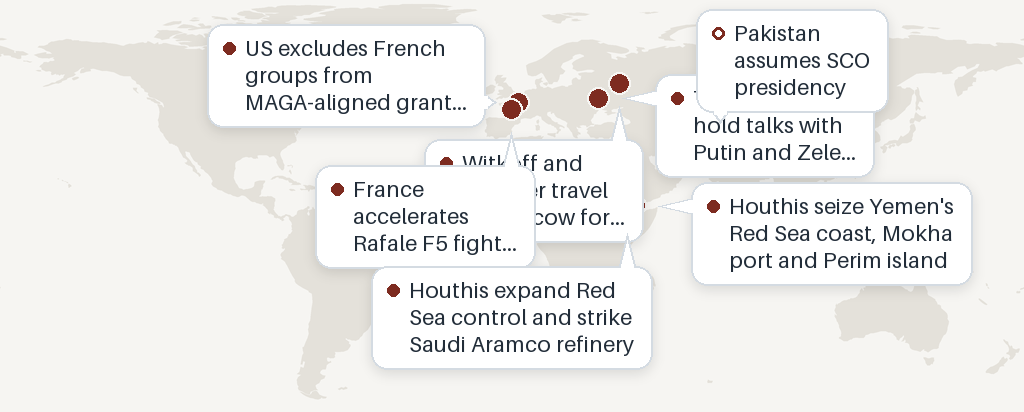
● this issue
Storyline I
The Ukraine war
| dormant | background | elevated | hot | critical |
7.3 of 10 · heating ↗
|
This week · Complication The Witkoff-Kushner trip converted the W36 'imminent shuttle' into fact, but the Kremlin's own 'useful, no breakthrough' framing, paired with Russian strikes on Ukrainian airports before the Kyiv leg, confirms the divorced-diplomacy pattern flagged as a live risk last week rather than the optimistic 'concrete proposal' framing Trump advertised. None of the open questions on DPRK drawdown, sanctions-relief specifics, or Azerbaijan-track coordination moved from unconfirmed to confirmed; three negotiating channels (US shuttle, Azerbaijan, and now a possible Ratcliffe swap-in) remain uncoordinated on the public record. Meanwhile the war's material track kept compounding independently of the talks: Ukraine's EU loan flexibility, Canada's air-defense pledge, and the Shershen system extend the localization-and-diversification pattern running since W30, while Russia's jet-powered drones and Ukraine's 1,700-mile refinery strikes show both sides still racing capability rather than de-escalating. The net effect is that diplomacy generated motion without traction, while attrition and arms-buildup continued on their own schedule. Talks can happen and the war keeps going anyway. |
Witkoff and Kushner travel to Moscow for Ukraine peace talks
Steve Witkoff and Jared Kushner arrived in Moscow to open the US-mediated shuttle previously scheduled at W36, with a Kyiv leg still to follow. Trump publicly characterized the US as bringing a fresh, concrete proposal to the table, though no content has been disclosed. No readout, Kremlin statement, or Ukrainian reaction has yet been reported.
| Alliance Politics (Entrapment–Abandonment) | The Moscow-first sequencing flagged as an open question at W36 is no longer hypothetical: Ukraine's first substantive exposure to whatever Witkoff and Kushner carry will come after Moscow has already reacted to it, not before. That is the structural condition for the imposed-terms pattern the arc has been watching since the 2025 breakdown. Next: Zelensky's public statement following the Kyiv leg (expected within 48 hours of that visit, likely mid-to-late next week) will use consultative language if Kyiv genuinely shaped the proposal beforehand; language describing a document or framework 'presented' or 'to be reviewed' would confirm the fait-accompli pattern instead. |
| Deterrence Theory | Trump's claim of a 'concrete proposal' with no accompanying statement on weapons pipeline continuity or conditioning suggests, consistent with the W36 prediction, that Washington is still negotiating on access and trust rather than leverage. Next: If no US statement links this proposal to continued, accelerated, or conditioned Ukraine arms deliveries within the same week, that confirms the leverage-free negotiating posture already flagged; a pairing with any pipeline announcement within 10 days would mark a real shift. |
| Security Dilemma | Diplomacy is proceeding without any visible pause in the material trends this arc has tracked: Russia's doubled missile output (W31), its expanding Geran launch infrastructure (W34), and Ukraine's own accelerating localization efforts (W32, W35, W36) all continue in parallel to the talks rather than being suspended by them. Next: Expect no announced Russian halt to Geran site construction or missile production during or immediately after the Moscow leg; continued strikes or site expansion within the following 1-2 weeks would confirm the pattern of talks and battlefield activity running on separate tracks, as in Minsk-era precedent. |
| Analogue | Paris Peace Accords (1972-73), Kissinger-Le Duc Tho secret channel — A great-power mediator negotiates core terms bilaterally with the adversary capital before presenting the outcome to the smaller allied government whose territory is actually at stake, producing resentment and last-minute demands for changes. Where it breaks: Zelensky retains battlefield leverage, domestic legitimacy, and direct US media access that Thieu's Saigon government lacked, meaning Kyiv's capacity to publicly push back or stall is materially greater. |
| Analogue | Minsk II (February 2015) — A negotiated framework was signed while fighting and territorial gains (Debaltseve) continued on the ground, producing an agreement immediately undermined by the military reality it was meant to freeze. Where it breaks: Minsk was a European-brokered trilateral contact-group process; this shuttle is a direct US bilateral channel with Moscow, which changes who bears responsibility if the diplomatic and battlefield tracks diverge again. |
Trump envoys hold talks with Putin and Zelensky on ending war
Witkoff and Kushner spent three hours with Putin in Moscow, then made their first-ever visit to Kyiv to brief Zelensky, completing the trip flagged as imminent in the prior entry. Trump separately called Putin, reportedly dangling swift restoration of US-Russia trade as the payoff for ending the war. The Kremlin termed the Moscow talks 'useful' but explicitly denied any breakthrough, and Russian strikes hit Ukrainian airports and infrastructure in the run-up to the Kyiv leg.
| Deterrence Theory | Striking Ukrainian airports and infrastructure on the eve of your own peace envoys' Kyiv visit is a signal, not a coincidence: Moscow is showing it can negotiate and punish simultaneously, which only works if Kyiv's air defenses can't reliably stop it. That's the same salami-tactic logic already flagged at W31 (missile-volume doubling) and W34 (Geran rail expansion), now applied to the diplomatic calendar itself. Next: Expect Russian strikes to continue or intensify around any future US-brokered talks through at least the next round, with no explicit US statement conditioning weapons flow or aid on a strike pause within 30 days. |
| Alliance Politics (Entrapment–Abandonment) | Kyiv again gets the second stop, not the first, on its own war's peace shuttle. The 'first-ever Kyiv visit' framing softens but doesn't erase the sequencing problem flagged at W36: Zelensky is being briefed after Moscow, not consulted before it. Next: Watch Zelensky's public statement in the next 5-7 days for language distinguishing 'we were consulted' from 'we received a proposal'; if he uses framework, plan, or document language, that confirms continuity with the imposed-terms pattern rather than genuine co-drafting. |
| Economic Interdependence & Weaponization | Trump pitching trade normalization as the prize for ending the war is the carrot version of the sanctions stick, an attempt to make peace pay better than continued fighting for Moscow. Atlantic Council's read, that Putin's war is imperial restoration rather than a land deal, argues the economic incentive undersells what Putin thinks he's fighting for. Next: No concrete sanctions-relief offer, timeline, or Russian economic concession will be confirmed within 30 days; the trade-restoration pitch will stay rhetorical, used by Moscow to differentiate Washington from EU sanctions hawks without costing Putin anything. |
| Analogue | Paris Peace Talks, 1968-1973 — US diplomats pursued a negotiated exit while bombing (and enemy offensives) continued on the ground, treating military pressure and talks as parallel tracks rather than sequential ones. Where it breaks: There the US itself controlled the bombing lever it was using alongside talks; here Russia is the belligerent doing both the striking and the negotiating, so Washington has no equivalent lever to pair with its diplomacy short of the aid pipeline it isn't yet conditioning. |
| Analogue | Minsk II, February 2015 — A great-power-brokered framework announced amid active fighting, with the guarantor powers absent from the front line themselves. Where it breaks: Minsk was multilateral (Normandy Format, four capitals with skin in the game); this is a bilateral US-Russia track with Kyiv informed after the fact, a narrower and more fragile guarantor structure. |
Also this week
— EU allows Patriot purchases via loan — Brussels lifted the European-content restriction on 6.1B euros of Ukraine Support Loan funds, extending the pipeline-flexibility pattern without altering its trajectory.
— Ratcliffe poised to replace Witkoff — Reports of a hardline CIA-director takeover of the negotiating track add personnel uncertainty just as the Moscow-Kyiv shuttle's substance is already thin.
— Canada pledges air defense and joint production — Ottawa's $350M JUMPSTART pledge and '100-year partnership' confirm the co-production playbook spreading to a new patron rather than breaking new ground.
— Russia deploys 300mph jet-powered drones — Daily launches of interceptor-outpacing drones sharpen the air-defense shortfall problem already flagged around Patriot scarcity and Ukraine's production-timeline race.
What to watch for in the upcoming weeks
— Official readout from the Moscow leg specifying substance discussed (within days)
— Kremlin, Lavrov, or Peskov statement characterizing the proposal's content or tone (within days)
— Confirmation of the Kyiv leg's date and any shift from the original schedule (within a week)
— Zelensky's public statement after the Kyiv leg, watched for consultation versus presented-framework language (within 48 hours of that leg)
— Any leak of proposal text or terms via US, Russian, or Ukrainian media prior to the Kyiv leg (days)
— Russian strike activity or Geran-site construction reporting in the 1-2 weeks following the Moscow leg, testing whether talks are paired with any battlefield restraint
— Zelensky's public statement following the Kyiv leg, watched within 48-72 hours for consultation versus presented-framework language
— Any Kremlin or MFA statement in the following 1-2 weeks referencing DPRK support, sanctions, or territorial conditions as agenda items from the Moscow leg
— Confirmation or denial of a scheduled follow-on Trump-Putin or Trump-Zelensky summit within 1-2 months
— Russian strike tempo against Ukrainian infrastructure in the 1-3 weeks immediately following the visit, as a test of whether diplomacy produces any battlefield restraint
— Any US statement linking continued Ukraine aid or weapons deliveries to Russian negotiating behavior, within 30 days
— Azerbaijan-track or German government statement addressing coordination or divergence with this US-led shuttle, within 2-4 weeks
Storyline II
US–Iran confrontation and Middle East realignment
| dormant | background | elevated | hot | critical |
7.0 of 10 · heating ↗
|
This week · Advance The week's decisive development is the Houthi seizure of Mokha and Perim plus the Jazan refinery strike, which converts the chokepoint-proliferation risk flagged since W31 from rhetoric into territorial fact: Iran's most capable proxy now sits astride the second global shipping strait, not just Hormuz. Saudi Arabia's answer was unilateral airstrikes and a pipeline shutdown, not invocation of the Mecca pact signed in W32, giving the clearest evidence yet that the Turkey-Pakistan treaty is a hedge on paper rather than an operational shield when actually tested. That gap matters more because the pressures on Washington's side have not eased: the W32 munitions constraint remains unaddressed, the diesel shock is now visibly domestic, South Korea's deployment and the Moron basing expansion show allies managing exposure on their own terms, and BRICS is now convening with Iran at the table on oil policy, deepening the Beijing-Moscow-Tehran alignment the storyline has tracked since its outset. Iraq-launched strikes on the East-West pipeline, itself the designated Hormuz bypass, mean both the primary and backup Saudi export routes are now contested simultaneously, a compounding rather than merely parallel risk. The lesson: when a treaty is tested for the first time, states default to old habits, and Riyadh's habit is still to act alone. |
Houthis seize Yemen's Red Sea coast, Mokha port and Perim island
Houthi fighters routed Yemeni government forces along the Red Sea coast this week, seizing the port of Mokha and the strategic island of Perim in the Bab al-Mandab Strait, displacing roughly 50,000 civilians. Saudi Arabia responded with airstrikes on Mokha airport and shut down a pipeline after a separate drone attack launched from Iraq. The advance is the Houthis' most significant territorial gain in years and puts Iran's most active proxy in position to threaten a second global shipping chokepoint alongside the ongoing Hormuz standoff.
| Deterrence Theory | Nothing currently punishes Houthi territorial expansion itself, only anticipated strikes on shipping. General deterrence of the Houthis, weak since the 2023-24 Red Sea campaign, has effectively collapsed on Saudi's southern flank while US attention and munitions remain tied up on the Iran-direct front (per the W32 exhaustion finding). Next: Expect at least one Houthi missile, drone, or naval mine incident against Saudi-linked or third-flag shipping transiting Bab al-Mandab within 4 weeks, since the territorial gain currently carries no cost. |
| Alliance Politics (Entrapment–Abandonment) | This is the first real test of the Mecca pact (W32): a proxy, not a state, threatens Saudi shipping and near-border territory, and Riyadh's initial response (airstrikes on Mokha airport) looks unilateral rather than pact-invoking, echoing 2015-style self-help. Next: No formal Saudi invocation of Pakistani or Turkish pact obligations within 4 weeks (~75% likely); Riyadh instead escalates its own air campaign, which would confirm the pact is currently a nuclear-shadow deterrent rather than an expeditionary commitment. |
| Economic Interdependence & Weaponization | This converts the W31 forecast of 'chokepoint proliferation' from prediction to fact: Iran-aligned forces now hold ground at Bab al-Mandab at the same time Hormuz remains contested, doubling the points at which roughly a fifth of world oil-and-container traffic can be squeezed. Next: Expect Lloyd's/Baltic Exchange war-risk premiums for Bab al-Mandab transits, tracked separately from Hormuz, to rise within 1-2 weeks, and at least one major carrier to announce further Cape of Good Hope rerouting within a month. |
| Analogue | 2015 Houthi seizure of Sanaa triggering Saudi Operation Decisive Storm — Houthi territorial gains near Saudi's border and shipping lanes provoked direct Saudi military intervention within weeks. Where it breaks: That campaign became a decade-long stalemate and humanitarian catastrophe without dislodging the Houthis; Saudi Arabia now has far less spare capacity given its own exposure to the concurrent US-Iran war and Hormuz risk. |
| Analogue | 2019 Abqaiq-Khurais drone strike — Iran-enabled forces used forward positioning to reach deep into Saudi economic infrastructure, showing territorial depth converts into strike reach. Where it breaks: That was a single facility hit; the current threat is to a transit chokepoint itself, raising the stakes to global shipping and insurance markets rather than one country's oil output. |
Houthis expand Red Sea control and strike Saudi Aramco refinery
Houthi forces captured the port of Mokha from Saudi-backed Yemeni factions and reportedly took two islands controlling approaches to the Bab al-Mandab Strait. Days later they launched a large missile-and-drone strike that set fire to the Saudi Aramco refinery at Jazan, along with hits near Abha, Najran and Khamis Mushait. The Houthi commander's own account describes the advance as Iran-planned; Saudi officials confirmed the attack and vowed retaliation.
| Deterrence Theory | This is a textbook salami sequence: port, then islands, then a strike on the kingdom's own refining capacity, each step testing whether Riyadh's response threshold has moved since the Mecca pact was signed. If Saudi Arabia answers with statements rather than strikes on Houthi-held Mokha or the islands, that tells the Houthis and Tehran the pact hasn't changed the calculus yet. Next: Expect at least one further Houthi probe against Saudi energy or port infrastructure within 4-6 weeks if Saudi retaliation in the next two weeks is limited to airstrikes rather than a ground or naval response to retake Mokha. |
| Alliance Politics (Entrapment–Abandonment) | This is the first real-world test of the Mecca pact's substance rather than its signature. The open question from W32 (unilateral 2015-style response vs. invoking Pakistan/Turkey) is now live: Saudi has been hit on its own soil, which is exactly the scenario the pact was supposedly built for. Next: Likely (~65%) Saudi Arabia responds with its own air campaign against Houthi positions within 1-2 weeks without any confirmed Pakistani or Turkish force contribution, reverting to the 2015 pattern to show the pact is declaratory rather than operational for now. |
| Economic Interdependence & Weaponization | Striking a refining asset directly, rather than harassing tankers, moves the Red Sea threat from a chokepoint-transit problem to a chokepoint-plus-production problem, which compounds the Hormuz blockade already priced into Brent above $100. This lands on top of W34's UAE embargo and Golden Dome funding strain, creating a second physical-supply shock rather than just a rerouting cost. Next: Expect a discrete Brent/WTI price move (likely 2-5%) attributable specifically to the Jazan strike within 48-72 hours, and at least one insurer or shipping line publicly citing Bab al-Mandab territorial control (not just harassment) as a new underwriting factor within 2-4 weeks. |
| Analogue | 2019 Abqaiq-Khurais strike on Saudi Aramco — Iranian-linked drone/missile strike on core Saudi oil infrastructure causing an immediate global price spike and a credibility test for Riyadh's air defenses. Where it breaks: Abqaiq hit roughly 5% of world oil supply at the primary processing hub; Jazan is a smaller, more replaceable refinery, so the physical market shock is likely to be sharper in headlines than in barrels. |
| Analogue | Saudi intervention in Yemen, 2015 — A Houthi territorial advance triggering a Saudi-led coalition response built without waiting on outside patrons. Where it breaks: Saudi Arabia now has the Mecca pact as a nominal alternative to unilateral action, meaning this event tests whether 2026 Riyadh behaves differently than 2015 Riyadh, not whether it will respond at all. |
Also this week
— Saudi East-West pipeline shut after Iraq-launched drone strike — The Hormuz bypass route itself is now compromised, meaning Saudi Arabia's two main export arteries are simultaneously contested.
— US prepares potential strikes on Pickaxe Mountain, Trump-Hegseth invoke 9/11 — New Mexico test-site activity and September 11 framing signal hardening US intent without yet resolving the capability strain flagged since W32.
— Iran captures US Navy submersible drone — A direct if recurring kinetic contact point that tests whether Washington treats seizure as routine or escalatory.
— BRICS confers with Iran on oil prices — Confirms Iran's deepening tilt toward Beijing and Moscow as a economic-management channel, though bloc unity remains thin.
What to watch for in the upcoming weeks
— Scale and duration of Saudi airstrikes on Houthi-held Mokha/Hodeidah positions, next 2-4 weeks, testing whether this becomes a renewed Decisive-Storm-style campaign
— Any Saudi statement referencing Pakistani or Turkish pact support in response to the Houthi advance, within 4 weeks
— Lloyd's/Baltic Exchange war-risk premiums for Bab al-Mandab transits specifically, distinguished from Hormuz premiums, within 1-2 weeks
— Iranian state media claiming credit for or distancing from the Houthi advance, within days
— Egyptian Suez Canal traffic/revenue data reflecting further rerouting, within 1-2 months
— Any Houthi attempt to stop, board, or fire on a vessel transiting Bab al-Mandab, within 4 weeks
— US or coalition naval statements on new Red Sea escort or patrol commitments, within 2-4 weeks
— Saudi airstrikes or ground operations aimed at retaking Mokha or the islands, within 1-2 weeks
— Official Pakistani or Turkish statement invoking the Mecca pact in response to the Jazan strike, within 2-4 weeks
— Confirmed Aramco production/export loss figures from the Jazan fire, within days
— Brent crude price movement specifically attributed by traders/analysts to the Jazan strike versus prior Hormuz/blockade news, within 48-72 hours
— Any reported Houthi boarding, seizure, or interdiction attempt against a vessel transiting Bab al-Mandab using the newly held territory, within 4-8 weeks
— Lloyd's/Baltic Exchange war-risk premium changes specifically citing Mokha/island capture, within 2-4 weeks
Storyline III
Europe's struggle for strategic autonomy
| dormant | background | elevated | hot | critical |
6.7 of 10 · steady
|
This week · Confirmation The week's two deep dives both point the same direction: capability and leverage are accruing to nation-states, bypassing EU institutions. Rafale F5's acceleration is FCAS's actual death, the fourth straight week (after Germany's missile program, the UK-France-Ukraine strike deal, and German drone plants) in which concrete European rearmament delivery bypassed joint EU pooling entirely, but this time the flagship Franco-German project itself is failing, unlike earlier national hedges running alongside it. Meanwhile Barrot's direct ministerial threat, tied to a pending French Senate bill, got Washington to carve France out of its MAGA-grant program within weeks, a faster and cleaner win than anything Brussels-level diplomacy has produced against the space-summit pressure campaign from W36. That contrast answers one of the tracked open questions early: the US treats France as a state with real levers to pull while ignoring EU standing to object, so the 'adversarial posture' question resolves as bilateral and reactive, not systemic and principled. Energy policy tells the same story from the failure side, with the Court of Auditors confirming the EU has missed its own Russian-gas phase-out targets, a chronic execution gap that mirrors the defense-industrial one. The lesson for the record: European strategic autonomy is arriving, when it arrives at all, as a sum of national wins instead of a single European effort. |
US excludes French groups from MAGA-aligned grant program
The State Department confirmed that French applicants will not receive funding from a grant program advertised over the summer to support MAGA-aligned think tanks and advocacy groups across Europe. The exclusion follows a public warning from French Foreign Minister Jean-Noël Barrot against 'foreign interference' in France's 2027 presidential race, timed to a French Senate bill on disinformation and foreign interference due in October. The State Department insists the program 'does not and will not fund political parties,' while calling the overall allocation still under deliberation.
| Alliance Politics (Entrapment–Abandonment) | This is patron overreach meeting client pushback in a domain alliance theory rarely covers: domestic electoral sovereignty rather than military commitment. France treated a US soft-power funding scheme as a threat serious enough to invoke national-security legislation, and Washington folded on the France-specific piece rather than defend the program broadly, suggesting the exclusion is reactive containment, not a policy reversal. Next: Within 3-6 months, expect at least one other EU state with upcoming elections (Germany, Poland, Italy) to make a comparable demand once program allocations become public; absent that, the France carve-out will look like a one-off tied to Barrot's specific warning and pending legislation rather than a norm (~55% probability another state raises it in that window). |
| Economic Interdependence & Weaponization | Political grant funding functions here as a soft chokepoint, the same leverage logic as export controls or space-forum access, just aimed at ideology rather than industry. The US partial retreat shows the leverage is contestable when a target state has both the will and the domestic legal tools (the pending disinformation law) to make the cost of continuing visible. Next: Watch for France or the European Commission to cite this exclusion explicitly as precedent within 3 months when arguing for restricting US firm access to IRIS2 or Galileo contracts in the unresolved space-summit dispute (~30% probability of an explicit cross-reference). |
| Analogue | NED and USAID democracy-promotion funding during the Cold War and color revolutions — A US-funded program backing preferred political actors abroad under a democracy/rights framing, prompting the host government to invoke sovereignty and restrict access. Where it breaks: NED-style funding traditionally targeted authoritarian states to support liberal opposition; here the US is funding populist-right groups inside an established, allied democracy, reversing the usual target profile entirely. |
| Analogue | EU restrictions on RT/Sputnik funding of European far-right parties — A great power using grants or media funding to cultivate sympathetic political actors inside another polity's electoral system. Where it breaks: Russia's funding operated covertly and outside any formal state-to-state relationship; the US program is openly advertised by an allied government's own State Department, making the diplomatic remedy (a ministerial warning) available in a way it never was against Moscow. |
France accelerates Rafale F5 fighter upgrade
France's DGA has ordered the first high-risk development work (radar, engine, navigation, electronic warfare) for the Rafale F5 standard from Dassault, Thales, MBDA, and Safran, with the full development contract expected by year-end. This acceleration comes as the Franco-German-Spanish FCAS/NGF next-generation fighter program has effectively collapsed in its original form, leaving France without a credible joint path to a sixth-generation replacement. The F5, originally conceived as a bridge to FCAS, now looks set to carry French airpower well past 2033 largely on its own.
| Alliance Politics (Entrapment–Abandonment) | This is intra-European entrapment logic: France feared being locked into a joint program where German export-control vetoes and Airbus workshare disputes could hold French capability hostage to Berlin's political timetable, much as they did with past Eurofighter export fights. Rather than manage that risk through compromise, Paris is exiting to a sovereign national track, the same move it made in 1985 when it quit the Eurofighter consortium to build Rafale alone. Next: Watch for Germany and/or Spain to announce a rival fighter pathway (GCAP accession talks, a bilateral German-Spanish successor study, or formal FCAS/NGF restructuring without France) within 6-12 months; absent that, expect continued ambiguous 'FCAS is paused not dead' language from Berlin through at least Q1 2027. |
| Economic Interdependence & Weaponization | By retreating to an all-French supply chain (Dassault, Thales, Safran, MBDA), France regains full control over export licensing, the exact chokepoint that made joint European platforms politically fragile whenever Berlin objected to a sale (Saudi Arabia, Egypt precedents). This trades one dependency risk (German veto) for another (France alone bearing the R&D cost of a fifth-generation-plus jet without partner cost-sharing). Next: Expect at least one new Rafale export announcement or advanced negotiation within 6-12 months explicitly citing the F5's all-French industrial chain as removing prior German-linked export friction. |
| Deterrence Theory | The F5 is now doing double duty as both a mid-life upgrade and a de facto stopgap sixth-generation capability, meaning France's actual next-next-gen fighter timeline likely slips well past the original mid-2040s FCAS target. That slippage matters for extended deterrence credibility relative to US NGAD and Chinese sixth-gen programs already in flight testing. Next: No French government statement will commit to a firm post-F5, true sixth-generation program timeline before 2028; expect continued deliberate ambiguity on what comes after F5 through at least the next defense budget cycle. |
| Analogue | France's 1985 exit from the Eurofighter consortium — France left a joint European fighter project over industrial leadership and requirements disputes, then built the Rafale alone; it is repeating that exact move with FCAS. Where it breaks: In 1985 France left before major joint investment; this time a flying NGF demonstrator and years of shared R&D spending are being written down, a much larger sunk cost than the earlier split. |
| Analogue | UK's pivot from Anglo-French FCAS talks to Tempest/GCAP in the 2010s — A bilateral European sixth-gen fighter effort stalled over workshare and requirements, prompting the stronger partner to rebuild around a new, more compatible coalition rather than force the original partnership to work. Where it breaks: The UK found a new multinational partner (Italy, Japan) to replace the lost one; France so far shows no sign of seeking a replacement partner and is instead going fully national. |
Also this week
— EU allows Ukraine to use loan for Patriot purchases — Brussels relaxed loan rules so Kyiv can buy US-made Patriots, easing Ukraine's air-defense gap while deepening, not reducing, dependence on American supply chains.
— EU falls behind on ending Russian oil and gas imports — The Court of Auditors' finding that REPowerEU targets are unmet is the energy-track twin of the defense-track pattern: EU-level plans consistently underdeliver against declared ambition.
— Germany increasingly targeted by Russian sabotage — Growing German acknowledgment of hybrid targeting keeps the Bulgarian-nationals attribution question live without yet resolving it, reinforcing rather than advancing the deterrence track.
— US skips NATO meeting on wartime civilian protections — A minor but consistent data point of selective US disengagement from multilateral European-hosted forums, echoing the space-summit pressure without adding new weight.
What to watch for in the upcoming weeks
— State Department confirmation of final grant allocations by country once deliberation concludes (watch within months)
— Whether Germany, Italy, Hungary, or Poland request similar carve-outs ahead of national elections (watch 3-6 months)
— French Senate action on the foreign-interference/disinformation law (watch within weeks, October session)
— Any circumvention route, funding reaching French-linked groups via non-French intermediaries (watch 3-6 months)
— Any State Department or Vance statement framing the French exclusion as precedent-setting versus a one-off exception (watch within weeks)
— DGA signing of the overall Rafale F5 development contract, expected by end of 2026
— Any German MoD or Bundestag statement on FCAS/NGF's status or funding within the next budget cycle (watch within months)
— Announcement of a German-Spanish alternative fighter study or GCAP outreach from Berlin/Madrid (watch 6-12 months)
— New Rafale export negotiations or signings citing full French industrial/export control (watch 6-12 months)
— Whether French officials publicly declare FCAS dead versus merely 'paused' in statements accompanying the year-end F5 contract
Storyline IV
Russia's pursuit of great-power status
| dormant | background | elevated | hot | critical |
5.8 of 10 · steady
No significant movement this week.
Storyline V
US–China power transition
| dormant | background | elevated | hot | critical |
2.1 of 10 · steady
No significant movement this week.
|
Wildcard Pakistan assumes SCO presidency — Pakistan has taken over the presidency of the Shanghai Cooperation Organisation, with expectations that it will promote new connectivity routes via Iran and Central Asia linking the Belt and Road Initiative to the Arabian Sea. (Pakistan's SCO presidency is a genuine shift in agency within the organization, moving it from a secondary player to helm a body coordinating major powers (China, Russia, India) on contested Belt and Road connectivity architecture through Iran and Central Asia. That shift could either operationalize SCO as a counterweight to Western-led infrastructure frameworks or expose the organization's structural contradictions, either outcome mattering enough for a historian to mark as consequential.) — possible new storyline? |
|
Idea or discussion? Hit reply. irlens.apps.pompadour.ventures |