Weekly geopolitical storylines
IR Lens
Week 2026-W40 · 4 October 2026
|
Editor's note I'm moving the weekly digest to Saturday, so I can do the editorial on Friday instead. I'm still working on further polishing language and length. Do remember this is still a beta! |
A relatively quiet week. All the various sides are busy with building leverage for eventual talks. Talks will be settled by facts already in place. The week's evidence is mostly announcement: the FP-7 claim comes with no stated target, range or warhead.
|
In this issue 01 The Ukraine war — Russia and Ukraine both escalated their strike campaigns this week, Kyiv claimed its first indigenous ballistic missile in combat, and the diplomacy produced nothing concrete. 02 Europe's struggle for strategic autonomy — no significant movement. 03 US–Iran confrontation and Middle East realignment — no significant movement. 04 Russia's pursuit of great-power status — Moscow brought an oil-for-sanctions-relief offer to Washington while European sabotage attribution stayed in newspapers, so Russia is pursuing relief at no visible cost to itself. 05 US–China power transition — While Trump and Xi traded pleasantries in Washington, the US moved a missile launcher to Yonaguni and China pressed the Philippines near Taiwan. |
● this issue
Storyline I
| dormant | background | elevated | hot | critical |
6.5 of 10 · heating ↗
|
This week · Advance Both sides raised the price of the air war this week while diplomacy stayed thin. Russia hit Kyiv's Dnipro bridges for the first time. Ukrainian drones set refineries and a tank farm ablaze in three regions; Putin put the losses near 1% of GDP but refused to trade a halt for an end to attacks on Ukrainian ships. Zelensky then announced the first combat use of the FP-7 ballistic missile, with only a launch video. The timing is consistent with Kyiv wanting a bargaining card before the UAE round proposed in W39, though that is inferred. A launch announcement is not a capability until someone shows what it hit. |
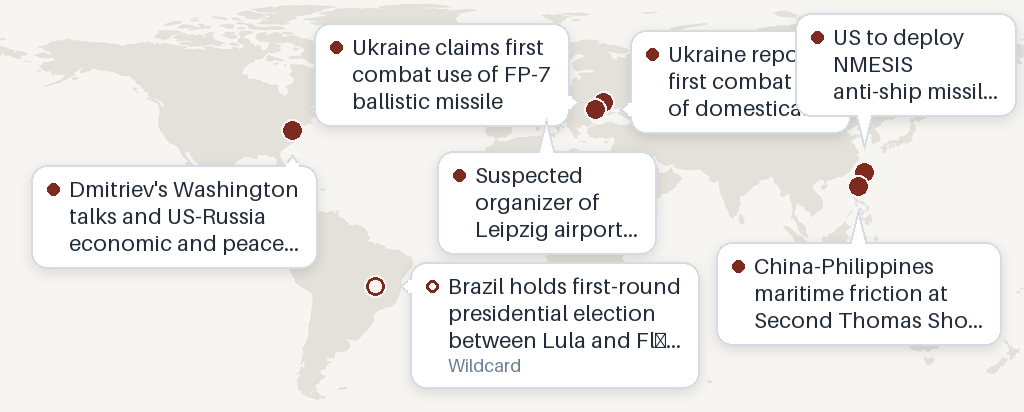
Ukraine claims first combat use of FP-7 ballistic missile
On Oct 1 Zelensky announced the first combat use of the FP-7, a ground-launched tactical ballistic missile from Fire Point, and said production comes next. A nighttime launch video was released. Ukraine has not disclosed the target, location, number fired, range or warhead, and nothing is independently verified.
| Deterrence Theory | Known: the announcement came with no target, range or count, while a US-proposed UAE round (W39) is still being arranged. Inferred: Kyiv wants Moscow to price in a strike option it can use without a Western release decision, since Washington has not tied arms flow to Russian behavior (W37). The missile's range, which decides how much that threat is worth, is unknown. Next: If Ukraine or imagery shows no target, impact site or damage for this launch by Oct 31 (~60%), treat it as a demonstration firing of a handful of rounds. |
| Alliance Politics (Entrapment–Abandonment) | Berlin's Taurus hesitation and the London-Paris Storm Shadow arrangement (W35) both rest on patrons keeping some say over Ukrainian targeting. An indigenous missile removes that say. Kyiv's fear of abandonment drops, and the patrons' ability to restrain it drops with it, which is the moral-hazard side of the same fact. Next: No Western government will change its Taurus or Storm Shadow authorization terms while explicitly citing the FP-7 within 60 days (~85%). |
| Analogue | Neptune and the Moskva, April 2022 — Ukraine's first publicized combat use of a home-built missile was a claim Moscow first contradicted, until the ship's loss settled it. Where it breaks: The Neptune claim named a target that Russia then had to account for, while the FP-7 claim names nothing that can be checked. |
Ukraine reports first combat use of domestically made ballistic missile
President Zelensky announced the first combat launch of a Ukrainian-made ballistic missile, which NYT reports he trumpeted as a milestone for indigenous long-range strike. The reporting we have gives no range, warhead, target or damage figures. The system is presumably the FP-7 already tracked in our open questions; the excerpt does not confirm that.
| Alliance Politics (Entrapment–Abandonment) | Kyiv has seen the Witkoff-Kushner round end at 'useful, no breakthrough' (W37) and Germany's Taurus decision stall (W35). A missile that needs no foreign release approval hedges against abandonment, and Zelensky can show it at a table where Washington has not conditioned its own leverage. That motive is inferred; the announcement itself is only Zelensky's claim. Next: No Western government will cite the FP-7 as a reason to change its Storm Shadow or Taurus authorization stance within 6 weeks (~85%), so the permission debate runs on unchanged. |
| Deterrence Theory | Punishment-based deterrence needs volume and credibility. A ballistic missile is harder to intercept than the slow cruise missiles and drones Ukraine has relied on, and it speaks to the cost-imposition gap opened by Russia's doubled missile output (W31). One launch with no disclosed range or damage proves a prototype can fly, not that a program exists. Next: A second publicly reported combat launch of the system occurs within 8 weeks (~50%); silence past that point would suggest a one-off demonstration rather than serial production. |
| Analogue | Israel's Jericho program after France's 1967 arms embargo — A client facing patron conditionality builds its own long-range missile so the patron can no longer veto its use. Where it breaks: Israel built in peacetime behind secure borders, while Ukraine is building under daily Russian strikes and, by our inference, still relies on imported components. |
Also this week
— Dmitriev's Washington talks — The reported multi-billion-dollar oil pitch shows Moscow courting US economic channels, but the Kremlin's regret that Washington still ties economics to peace means no verifiable sanctions-relief offer exists yet.
— Russia's 2027 budget raises war spending — Higher military outlays, new debt and taxes, and lower social benefits, partly in response to refinery strikes, show Moscow paying for a long war rather than preparing for a settlement.
— Merz's unannounced Kyiv visit — A German chancellor arriving as the Northern Bridge was being struck confirms Berlin's support is steady, with no new commitment attached.
— Ukrainian UGV counteroffensive near Kostiantynivka — Reports that robotic ground vehicles reversed over a year of Russian gains are unverified, but they fit Ukraine's pattern of substituting machines for scarce infantry.
What to watch for in the upcoming weeks
— Ukrainian or OSINT disclosure of FP-7 target, damage, or range within about three weeks
— UAE round date, attendance level, and Kremlin conditions, expected within 1-2 weeks
— Any verifiable US sanctions-relief or oil-deal offer to Moscow within about 60 days
Storyline II
Europe's struggle for strategic autonomy
| dormant | background | elevated | hot | critical |
5.5 of 10 · cooling ↘
No significant movement this week.
Storyline III
US–Iran confrontation and Middle East realignment
| dormant | background | elevated | hot | critical |
5.4 of 10 · cooling ↘
No significant movement this week.
Storyline IV
Russia's pursuit of great-power status
| dormant | background | elevated | hot | critical |
5.3 of 10 · steady
|
This week · Advance Russia needs money and fuel: Putin put refinery losses at about 1% of GDP at Valdai, fuel is scarce in Moscow, and the 2027 draft budget adds debt and taxes. That is the likely reason Kirill Dmitriev spent the week in Washington with an oil deal on the table, the first commercial content in a channel that until now carried prisoners and warnings. Peskov's complaint that Washington still links trade to peace shows the price is unchanged, so relief before a ceasefire framework looks unlikely (~20%). In Europe, a Telegraph investigation named Leipzig's organizer and tied him to Unit 29155, yet no government has acted on the names. Moscow is offering Washington business while its saboteurs face nothing worse than newspaper headlines in Europe. |
Dmitriev's Washington talks and US-Russia economic and peace discussions
Kirill Dmitriev met Treasury and Energy officials in Washington to discuss Ukraine and energy projects, according to Reuters sources. The NYT reports the agenda includes a multi-billion-dollar oil deal that Putin raised with Witkoff and Kushner in the Kremlin on Sept. 5. Peskov said Moscow regrets that Washington still links economic ties to peace, and denied any talks on trading political prisoners for sanctions relief.
| Alliance Politics (Entrapment–Abandonment) | Moscow's incentive is to turn Washington from sanctioner into business partner, and an oil deal does that more cheaply than any concession on Ukraine. Europe sits on the wrong side of the table. Berlin formally accused Russia over Leipzig (W36), Trump waved it off days later, and now Treasury hosts the envoy. This is consistent with European abandonment fear; the deal's terms are unreported. Next: At least one of Germany, Poland, or a Baltic government will publicly warn against a US-Russia oil arrangement that bypasses EU sanctions within 4 weeks (~50%), framed as sanctions integrity rather than criticism of Washington. |
| Power Transition / Thucydides Trap | Peskov's regret is a dissatisfaction statement: Russia wants economic normalization as recognition of its standing, without paying for it with a Ukraine settlement. That Washington still ties the two means the sanctions lever has not been spent. The prisoner denial shows Moscow refuses to let releases be priced as concessions, unlike the W33 pardon, which it presented as goodwill. Next: No OFAC delisting or general license covering Russian oil exporters will be issued within 8 weeks unless a ceasefire framework is signed first (~80%). |
| Analogue | Siberian pipeline dispute, 1981-82 — An energy deal with Moscow split the Atlantic allies over whether commerce should be conditioned on Soviet behavior. Where it breaks: Then Washington was the objector and Western Europe the buyer; now the patron is the one courting Moscow while Europe is cutting Russian energy and hardening against hybrid attacks. |
Suspected organizer of Leipzig airport sabotage identified
The Telegraph, drawing on Agentstvo's leaked-data reporting and Süddeutsche Zeitung material, named Russian Oleg Levushkin as suspected organizer of the Leipzig drone attack on a Ukrainian cargo aircraft, and Belarusian Andrei Karshakov as its perpetrator. It links Levushkin to GRU colonel Denis Smolyaninov and to Unit 29155, the Skripal unit. German authorities have named neither man.
| Deterrence Theory | Moscow used a Riga-linked businessman and a Belarusian operative for the usual reason: cutouts keep officers off the scene and preserve denial. The leak partly defeats that. Known: the names and the Smolyaninov tie rest on press reporting and a 2007 acquaintance. Inferred: a tasked GRU operation, which is consistent with Berlin's W36 attribution but does not prove it. Next: Germany's federal prosecutor or BKA publishes a warrant or wanted notice naming Levushkin or Karshakov within three months (~30%); otherwise this stays a press event that adds no cost for Moscow. |
| Alliance Politics (Entrapment–Abandonment) | Britain holds the Skripal attribution and the Unit 29155 file, so a Telegraph story invites its government to speak. If London ties Leipzig to the unit, European hardening proceeds without Washington, where Trump dismissed Berlin's accusation days after it was made (W36). Silence from London would suggest the evidence is thinner than the press framing. Next: The UK government issues a statement or sanctions designation explicitly tying Leipzig to Unit 29155 within eight weeks (~25%). |
| Analogue | Vrbětice ammunition depot explosions (Czech Republic, 2014; attributed 2021) — Same unit, same method: deniable sabotage on allied soil, later pinned to 29155 officers. Where it breaks: Prague waited seven years and the suspects were officers travelling on their own cover passports, whereas Leipzig was attributed within months and the named figures look like contracted intermediaries. |
Also this week
— Finnish lawmakers report home intrusions — The prime minister's mention of possible foreign forces fits the pattern of intimidation aimed at European political elites, but there is no formal attribution yet.
— Putin warns of all-weapons defense of Kaliningrad — The nuclear-inclusive warning repeats established deterrence rhetoric with no change in posture, and it arrives as Moscow seeks a commercial opening with Washington.
— Ukrainian refinery strikes and Russia's 2027 budget — Putin's own 1% of GDP loss figure and a budget adding debt and taxes supply the financial pressure behind Moscow's interest in oil-sector sanctions relief.
What to watch for in the upcoming weeks
— Any OFAC license, waiver or delisting for Russian oil entities before a ceasefire framework is signed
— German or EU sanctions or wanted-list entries for Levushkin, Karshakov or Smolyaninov, or Berlin linking Leipzig, the cache and Brandenburg
— Public objection from Berlin, Warsaw or Brussels to any US-Russia oil arrangement, versus continued silence
Storyline V
| dormant | background | elevated | hot | critical |
4.2 of 10 · heating ↗
|
This week · Advance Washington and Beijing spent three days in summit mode while their militaries kept working the seams around Taiwan. SCMP reports that the US will place NMESIS on Yonaguni, which adds a US-owned denial layer to the Japanese counterstrike buildup that has run since Week 31. Whether it stays after the exercise is not stated. China followed the Second Thomas Shoal clash with an exercise and a sovereign-rights claim over Batanes, probably to complicate Philippine basing on the Luzon Strait before it hardens (inferred). The summit has produced no disclosed terms, so the warmth is atmosphere and the deployments are fact. Summit warmth has not slowed either side's positioning around Taiwan. |
US to deploy NMESIS anti-ship missiles on Japanese island nearest Taiwan
Per SCMP, citing the regional bureau of Japan's defense ministry, the US will deploy the unmanned NMESIS anti-ship launcher to Yonaguni, in Okinawa prefecture, during biennial US-Japan exercises this month. It is the first such deployment to Japan's island closest to Taiwan. Whether the system leaves when the exercise ends is not stated in the report.
| Deterrence Theory | Washington and Tokyo want to hold Chinese warships and amphibious ships at risk in the roughly 110 km gap between Yonaguni and Taiwan, using a launcher that is cheap, mobile and hard to find. This is denial aimed at the opening days of a blockade or landing. The capability is clear, but credibility depends on whether it stays after the exercise. Next: China's MFA or MND will criticize the deployment by name (NMESIS or Yonaguni) within about two weeks (~75%), and PLA activity near Yonaguni during the exercise window will rise (~35%). |
| Alliance Politics (Entrapment–Abandonment) | Hosting a US launcher 110 km from Taiwan raises Japan's entrapment exposure more than America's. Yonaguni has about 1,700 residents, and Takaichi's earlier remarks on a Taiwan contingency already made Tokyo the more exposed party. The deployment turns that rhetorical commitment into a physical one. Next: Yonaguni's mayor or Okinawa's governor will publicly object or demand clarification within a month (~50%), and Japan's MOD will describe the deployment as temporary and exercise-only. |
| Analogue | Pershing II deployments in West Germany, 1983 — A patron placed new strike systems on a frontline ally's soil, and the host government absorbed the local political cost. Where it breaks: NMESIS is a conventional, anti-ship, short-range system with no decapitation timeline, so Beijing's threat perception and the escalation ladder are far less steep. |
China–Philippines maritime friction at Second Thomas Shoal and Batanes
After a confrontation at Second Thomas Shoal, China held a military exercise in the South China Sea. The Diplomat reads this as the collapse of the July 2024 provisional resupply understanding, though neither government has said so. Separately, China asserted "sovereign rights" over waters around Batanes, the Philippines' northernmost province in the Luzon Strait, and Manila rejected the claim. An Atlantic Council piece urges Manila and Washington to move first on port and presence there.
| Deterrence Theory | The 2024 arrangement capped how hard Beijing could squeeze the Sierra Madre garrison, and its apparent failure suggests Beijing now judges the cost of pressure as lower. The Batanes claim looks like a probe where US treaty coverage is thinnest: a coast guard dispute over an EEZ is not obviously an armed attack under the Mutual Defense Treaty. That reading is inferred, not stated by Beijing. Next: Philippine Coast Guard or AFP will publicly report Chinese coast guard or PLA Navy vessels operating in Batanes waters within 3 months (~60%), with a water-cannon or boarding incident there within 6 months (~20%). |
| Alliance Politics (Entrapment–Abandonment) | Beijing is pressing Manila while Washington is invested in the Trump-Xi summit track, and détente between patrons is when clients fear abandonment most. Manila gets more reason to pull the US into Batanes through basing, which is also the entrapment risk Washington carries over a Taiwan contingency. Whether Beijing timed this to the summit is inferred. Next: The US and Philippines will announce a named Batanes project (port, airstrip, EDCA site, or missile-system deployment) or a US statement naming Batanes under the treaty within 6 months (~35%). |
| Analogue | Natuna Islands standoff, Indonesia, 2019-20 — China asserted rights in waters around undisputed island territory and backed it with coast guard presence. Where it breaks: Natuna is far from Taiwan and Indonesia has no treaty ally, whereas Batanes sits on the Luzon Strait with a US treaty, EDCA access, and Taiwan-contingency relevance. |
Also this week
— Trump–Xi summit in Washington — Three days on trade, AI, rare earths and Taiwan produced no disclosed terms, so it sets a détente backdrop without yet constraining the deployments and claims above.
— Taiwan receives first F-16 Block 70 jets — Two of 66 jets arrived after nearly seven years of delay, a reaffirmation of US support that sits awkwardly beside the presidential hold on a separate large arms package.
— China opens military logistics and training facility in Laos — The site north of Vientiane, a counterpart to the Cambodian naval facility, deepens Beijing's mainland Southeast Asian footprint on a slower track than the Taiwan-gap contest.
— Chinese language teachers leave Philippines — About 150 teachers are going home after Philippine security officials called exchanges a national-security risk, a sign Manila's security establishment is hardening alongside the maritime friction.
What to watch for in the upcoming weeks
— Whether NMESIS stays on Yonaguni or elsewhere in the Nansei chain after the exercise, within 6 months
— Whether the next Sierra Madre resupply is blocked or water-cannoned, within 2 months
— Disclosed Trump–Xi terms on tariffs, rare earths or chips, within weeks
|
Wildcard Brazil holds first-round presidential election between Lula and Flávio Bolsonaro — Brazilians voted in a polarised, neck-and-neck first round pitting incumbent leftist Lula against Flávio Bolsonaro, son of the jailed former president Jair Bolsonaro, who was convicted of staging a coup. The race is seen as a test for a growing pro-Trump bloc in Latin America. (A Brazilian election between a leftist incumbent and a Bolsonaro-dynasty candidate representing a pro-Trump realignment crosses a threshold by potentially reversing five years of regional ideological direction and would anchor any future narrative about Latin America's geopolitical pivot away from the US-skeptical left, making it a plausible historiographical inflection point for tracking hemispheric realignment.) — possible new storyline? |
|
Idea or discussion? Hit reply. irlens.apps.pompadour.ventures |