Weekly geopolitical storylines
IR Lens
Week 2026-W43 · 24 October 2026
|
Editor's note No big updates, do remember that is still a beta! |
Moscow gained sanctions relief this week, with the US buying Russian diesel. Trump appears to want cheaper fuel, with Brent at $114.72 and the midterms two weeks away, and Putin has not moved on his terms. Again, US pressure lands on Kyiv, not Moscow.
There are some movements on Ukraine war negotiations. Possibly by mid-November in Abu Dhabi. Chance of it going through is quite big, because the meeting costs Moscow nothing. Don't expect a chanced stance on Donetsk from the Russian side.
|
In this issue 01 Russia's pursuit of great-power status — Washington eased oil sanctions on Russia before any ceasefire, and Putin paid only with a prisoner release and an offer to talk on unchanged terms. 02 The Ukraine war — Talks gained a date and a leaked outline, but Moscow has given up only a meeting and one prisoner while US pressure keeps landing on Kyiv. 03 US–Iran confrontation and Middle East realignment — Iran answered the unreturned Hormuz offer with more ship attacks and mines, Brent hit a five-month high, and the US began pulling diplomats from the region. 04 US–China power transition — no significant movement. 05 Europe's struggle for strategic autonomy — no significant movement. |
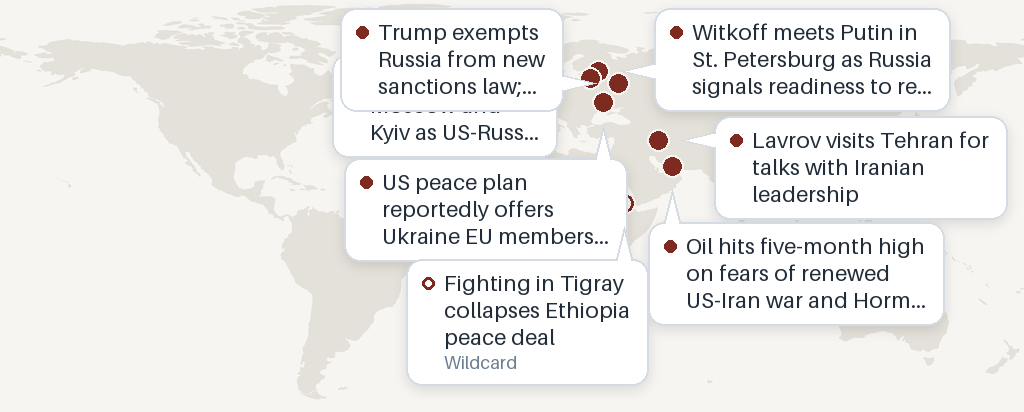
● this issue
Storyline I
Russia's pursuit of great-power status
| dormant | background | elevated | hot | critical |
7.4 of 10 · heating ↗
|
This week · Advance Moscow got sanctions relief this week without moving on its terms. Trump signed an order exempting Russia from the new sanctions law and Novak said a diesel tanker sails for the US; statute, sellers and volume are unreported. The motive is probably domestic fuel prices (inferred). Putin freed an American prisoner and offered trilateral talks, but only toward a settlement covering European security, and rejected a freeze on the line of contact. No reported link ties the talks to the sabotage files in Germany and Denmark. Lesson: Washington is easing oil sanctions on Russia before any ceasefire. |
Trump exempts Russia from new sanctions law; Russian diesel shipments to US begin
Trump signed an executive order exempting Russia from new sanctions legislation, citing US national interest. Deputy PM Novak said a tanker would leave for the United States on Thursday under the diesel deal, without giving the volume. The reporting does not name the statute, the sellers, or any waiver mechanism, and no US confirmation of the sailing is cited.
| Deterrence Theory | The new law was a standing penalty on Russia, and the order removes it for Russia entirely. That follows Germany's Leipzig attribution (W36), Denmark's defense-firm claim (W41) and the Starlink detentions (W42), none of which brought costs. Inferred: Moscow now reads US sanctions threats as negotiable, and European attributions as the only price of hybrid operations. Next: No new US sanctions designation on Russian entities is issued within eight weeks (~85%), while at least one new Russia-linked sabotage or airspace incident is reported in a NATO state within six weeks (~85%). |
| Alliance Politics (Entrapment–Abandonment) | The split is now between the White House and Congress, on top of the Washington-Berlin gap from W35-W36. Congress wrote a constraint and the president used the exemption in it, or an equivalent authority (the mechanism is inferred, not reported). Europe and Kyiv face abandonment on sanctions while the diesel supply chain gives Washington a reason to want Russian refineries and ports running. Next: Senators from both parties issue a letter, hearing demand or bill opposing the exemption within three weeks (~70%), but no Senate floor vote on blocking it occurs within six weeks (~85%). |
| Analogue | Reagan lifting the Soviet grain embargo (April 1981) — A US president relaxed sanctions on Moscow for domestic economic reasons with no Soviet concession. Where it breaks: The embargo cost US farmers a market, whereas this deal makes US fuel prices partly depend on supply from the sanctioned state, and it overrides a fresh statute rather than a presidential measure. |
Witkoff meets Putin in St. Petersburg as Russia signals readiness to resume peace talks
Witkoff met Putin in St. Petersburg on October 21, after consultations in Europe. Putin opened by announcing the release of US citizen Stephen Hubbard, and Witkoff called him a 'humanitarian'. Putin then said Russia is ready to resume US-Russia-Ukraine talks, but only toward a final settlement covering Russian, Ukrainian and European security. He called Zelensky's offer to freeze the line of contact a claim on 'historical Russia'. The Kremlin floated a Putin-Trump-Xi meeting next month. Republican senators attacked Witkoff, and Kyiv objected to talks without it.
| Alliance Politics (Entrapment–Abandonment) | Kyiv's abandonment fear rises. Witkoff briefed Europeans and then met Putin with no Ukrainian present, and Zelensky's public freeze offer was rejected within days. The counterweight is Congress: Ernst, Tillis and Cornyn criticized Witkoff, the same chamber that pushed back on the W42 diesel deal. Trump and Vance defended him, so the pressure is rhetorical so far (inferred). Next: Witkoff is still the lead US envoy on Russia on December 31 (~85%), and no ceasefire has been agreed by then (~95%). |
| Power Transition / Thucydides Trap | Putin's demand that a settlement cover 'Europe' repeats Russia's long-standing claim to rewrite European security terms, and a Putin-Trump-Xi format would give Russia a seat as one of three principals. That raises Russia's status without changing its power, which is well below China's. The reporting does not say Beijing has agreed to attend (inferred: no commitment yet). Next: Beijing does not confirm Xi's attendance, and no three-leader meeting takes place, before December 1 (~90%). |
| Analogue | Nixon's 1971-72 triangular diplomacy and the Paris talks — Washington negotiated with the other great powers while the embattled client, South Vietnam, objected from outside the room. Where it breaks: Nixon was trying to exit and held bombing and aid as leverage over Hanoi, whereas Trump is not withdrawing from a war and Beijing has not agreed to act as a broker. |
Also this week
— US peace plan reportedly offers Ukraine EU membership for dropping NATO bid — The Economist's unconfirmed account puts a NATO-for-EU trade and unspecified provisions for Russia on the table, which fits Putin's demand that talks cover European security.
— Starlink/Starshield restrictions on Ukraine's military persist despite Trump's claim — Ukrainian and European officials say the throttling continues after Trump said Musk had lifted it, so Washington's stated position and its practice on Ukraine's communications diverge again.
— Lavrov visits Tehran — The visit follows Trump's complaint that Russia is doing little for Iran in its war with the US and Israel, and shows Moscow keeping its Iran alignment while courting Washington.
— Russian barrages hit Kyiv after peace-talk announcement — Three waves struck Kyiv on October 22, hours after Putin said Russia was ready to talk, which is consistent with Moscow pairing diplomatic offers with continued strikes (war tracked separately).
What to watch for in the upcoming weeks
— Published statute, sellers and volume for the diesel exemption, and first US discharge, within 2-3 weeks
— Whether a US-Russia-Ukraine session convenes (Abu Dhabi, November) and Russia's agenda includes European security terms
— German, Polish, Baltic or Commission response to the diesel exemption, within 3-4 weeks
Storyline II
| dormant | background | elevated | hot | critical |
7.2 of 10 · heating ↗
|
This week · Advance Talks gained a date and a draft outline this week, but the terms did not change. Putin received Witkoff, released one American prisoner and accepted a trilateral round in mid-November, after the midterms. The leaked US plan offers Ukraine EU membership, which only Brussels can grant, for dropping NATO and accepting a demilitarized zone in the part of Donetsk Russia has not captured. Pressure again fell on Kyiv: Kushner repeated the request to stop refinery strikes, and Starshield throttling continued despite Trump saying Musk had lifted it. Moscow has been offered sanctions relief and a Donetsk buffer and has given up only a meeting and one prisoner. |
Witkoff visits Moscow and Kyiv as US-Russia-Ukraine trilateral talks revive
Witkoff met Zelensky and European officials in Oslo on Oct 20 (the event summary says Kyiv; the reporting says Oslo), then Putin in St. Petersburg on Oct 21. Putin released an American prisoner. Ushakov said trilateral talks could start in mid-November, after the midterms, possibly in Abu Dhabi, and Zelensky confirmed. Axios reports Kushner again asked Kyiv to stop hitting Russian refineries. The EU is searching for a negotiator Putin will talk to.
| Economic Interdependence & Weaponization | Moscow's incentive is to keep the war and the US commercial relationship on separate tracks, and the NYT says that is working. Washington has eased Russia's diesel constraint (W42) and is now pressing Kyiv, per Axios, to stop hitting refineries, which is Ukraine's one costly pressure on Russian fuel exports. The prisoner release costs Putin nothing. Next: Ukraine keeps striking Russian refineries or fuel terminals, with at least three reported attacks by Nov 21 (~75%), despite Kushner's second request. |
| Alliance Politics (Entrapment–Abandonment) | Kyiv confirmed the round immediately because refusing would make it the spoiler. Its abandonment fear is higher now that Rubio appears to confirm US-Russia-China summit talks and Putin refuses contact with von der Leyen, Kallas and Macron. The EU envoy search (Stubb, von der Leyen) is Europe's attempt to avoid being negotiated over. Next: EU leaders formally mandate a single negotiator for talks with Russia by Dec 15 (~25%), and Putin holds a direct call with any European leader by year-end (~10%). |
| Analogue | Nixon-Kissinger triangular diplomacy, 1971-72 — Washington arranged great-power summitry with Moscow and Beijing while the war ally's terms were decided around it. Where it breaks: South Vietnam depended on US troops and was being left, whereas Ukraine and Europe fund and arm themselves and can still refuse terms. |
US peace plan reportedly offers Ukraine EU membership for dropping NATO bid
The Economist reports the US plan would give Ukraine an investment program and EU membership in return for abandoning its NATO bid. Russia would get sanctions easing, partial restoration of ties with the West, and possibly resumed gas supplies to the EU. A demilitarized zone would cover the part of Donetsk Russia has not captured. Ukrainian officials reportedly know only outlines, and NYT sources say the EU has already rejected the idea.
| Alliance Politics (Entrapment–Abandonment) | Washington wants Ukraine to drop NATO, Russia's core demand, and pays with something it does not control: EU accession needs unanimity among 27 states. Kyiv seeing only 'outlines' is consistent with the imposed-terms pattern of W36-W37 and W41, though this rests on one report. Abandonment fear rises in Kyiv, and Brussels is asked to fund the bargain. Next: Zelensky will not publicly accept dropping the NATO bid, and no Rada or constitutional step toward renouncing it occurs, before Nov 30 (~90%). |
| Economic Interdependence & Weaponization | The Russian side of the package is economic: sanctions easing, restored ties, possible gas to the EU. It extends the W42 diesel deal, where relief went to Moscow with no reported Russian concession. The costs fall on Europe, which holds the gas and sanctions-renewal decisions, so Washington is bargaining with chokepoints it only partly owns. Next: OFAC or State publishes at least one further Russia sanctions easing beyond the diesel license by Dec 31 (~30%). |
| Analogue | Austrian State Treaty, 1955 — A great-power settlement traded neutrality, with no alliance membership, for sovereignty and a later route to Western integration. Where it breaks: Soviet troops left Austria, whereas this plan leaves Russia on occupied land, asks Ukraine to vacate more of Donetsk, and offers a membership the guarantor cannot deliver. |
Also this week
— Ukrainian drones hit Moscow, data centers and Surgut energy plant — Kyiv kept striking Russian infrastructure, including a Tax Service data center and Yandex facilities, in the same week Kushner asked it to stop hitting refineries, and Russia claimed over 1,000 drones downed in one night.
— Starlink restrictions persist despite Trump's claim Musk lifted them — Ukrainian and European officials said the throttling continued without explanation after Trump's call to Musk, so the White House's own statement did not match conditions on the front.
— Ukrainian arms maker rethinks Starlink reliance — A major Ukrainian manufacturer is reconsidering a dependency that the throttling has shown can fail, though no alternative contract has been announced.
— Putin's post-meeting terms and Trump-Putin-Xi idea — Putin said Russia is ready in principle to resume talks but wants a settlement covering security for Russia, Ukraine and Europe rather than a short ceasefire, while Witkoff's 'humanitarian' description of him angered US lawmakers.
What to watch for in the upcoming weeks
— Whether the trilateral round convenes by Nov 30 with all three delegations at working level
— Kyiv or Brussels publicly accepting or rejecting the Donetsk demilitarized zone, by Nov 15
— Ukrainian refinery strike tempo and any renewed Starshield degradation, over the next 30 days
Storyline III
US–Iran confrontation and Middle East realignment
| dormant | background | elevated | hot | critical |
6.5 of 10 · heating ↗
|
This week · Advance Washington has not answered Iran's six-day Hormuz offer, and this week the IRGC claimed four more ship hits while three other vessels struck mines near Hormuz. Brent reached $114.72, a five-month high. Reading the attacks as Tehran treating silence as a lapse is an inference, not established. The US order for some diplomats to leave Saudi Arabia, with similar moves reported in four other regional states, is consistent with Washington expecting more strikes. Lavrov's visit has produced no reported Russian deliverable. With stocks covering one to two months, a renewed closure would test Washington's tolerance before Tehran's. |
Oil hits five-month high on fears of renewed US-Iran war and Hormuz attacks
Brent rose about 3% on Thursday to $112 and about 1% on Friday to $114.72, the highest since May. The IRGC said it hit four vessels in the northern Gulf, and three more ships struck mines near Hormuz. Tehran threatened Gulf oil and tech facilities. Trump has not ruled out the 'mother of all bombs'. Stocks cover one to two months of a renewed closure.
| Economic Interdependence & Weaponization | Iran is using the chokepoint on a thin buffer. The mine strikes matter beyond this week's price: mines persist after any deal, so even Iran's W39 six-day offer could not restore flow quickly. With stocks at multidecade lows and the W38 East-West pipeline bypass offline, the cost of a closure reaches Washington's voters (diesel, W36) before it reaches Tehran's. Next: Brent settles above $120 at least once within 4 weeks (~30%), and a settle below $105 in that window needs an announced US-Iran negotiating track (~15%). |
| Alliance Politics (Entrapment–Abandonment) | The Atlantic Council piece says the Gulf states are drawing different conclusions from the war. This is consistent with the W38 split between Oman/Qatar mediation and Saudi/UAE military self-help. Iran's threat to Gulf oil and tech facilities raises entrapment fear for hosts that carry US basing without controlling US strike decisions. Which states are drawing which conclusion is inferred, since only the headline is available. Next: No GCC-wide communique setting out a common response to the Iranian threats appears within 4 weeks (~80%), and Qatar or Oman separately restates its mediation offer. |
| Analogue | 1987-88 Tanker War and Operation Earnest Will — Mines and small-boat attacks on Gulf shipping drew US naval involvement and split the Gulf Arab states over how far to go. Where it breaks: Then Hormuz never closed and Saudi spare capacity and stock cover were large, whereas now the bypass pipeline is offline and the buffer is one to two months. |
Lavrov visits Tehran for talks with Iranian leadership
Sergei Lavrov arrived in Tehran for talks with Iranian leadership. The trip follows Trump's claim that Russia is "doing very little, if anything" to help Iran against the US and Israel. The only tracked source is the Moscow Times, and it reports no agenda, deliverables or meeting readouts yet.
| Alliance Politics (Entrapment–Abandonment) | Iran's fear is abandonment, and Trump's remark publicly names the gap. Moscow's incentive is to be seen showing up without taking on entrapment in a war with the US. The January 2025 Russia-Iran treaty has no mutual-defense clause, so a foreign-minister visit is the cheapest available reassurance. This matches the BRICS pattern in W38: declaratory cover without material cost. Next: No Russian arms transfer, air-defense deployment or defense commitment to Iran is officially announced or credibly reported within 4 weeks (~80%); the visit's output stays statements, mediation offers and trade talk. |
| Deterrence Theory | Trump's comment describes Russia as an unengaged bystander, which lowers the perceived cost of escalating against Iran. Lavrov's trip is an attempt to blur that reading without changing capability. Moscow also gains from Brent near $100 since W38, so it has little reason to end the Hormuz disruption, only to appear relevant to it. Next: Washington announces no new sanctions or tariffs on Russia explicitly tied to aid for Iran within 4 weeks (~85%), and Trump does not retract the "very little" characterization. |
| Analogue | Russia's response to the June 2025 Israel-Iran war — Moscow condemned the strikes and offered mediation while giving Tehran no military help. Where it breaks: In 2025 Iran faced strikes only, whereas now it faces a blockade and a Hormuz standoff that raise Russian oil revenue, so Moscow's interest in prolonging the crisis is greater and its interest in intervening is no larger. |
Also this week
— Houthi strike on Dammam airport kills two — It extends the Houthi campaign against Saudi aviation from Riyadh to the Eastern Province, next to Aramco's headquarters, and it is the incident that prompted the US diplomatic drawdown.
— US-led coalition withdraws from Iraq — Baghdad got the foreign partners out before securing the compliance of armed factions, which leaves it with less leverage over Iran-aligned groups as the Hormuz confrontation sharpens.
— Iran rebuilds Eagle 44 underground airbase — Construction has continued through at least three rounds of strikes this year, consistent with Tehran planning to absorb further bombing rather than concede.
— Israel's election campaign enters final days — Eisenkot leads Netanyahu in the polls, but no result before the vote changes the Lebanon or Iran tracks this week.
What to watch for in the upcoming weeks
— Any substantive US response (accept, counter, reject) to the Hormuz offer, within 1-2 weeks
— Declared mine-clearance or escort operation, or an IEA/G7 stock release, within 3 weeks
— Foreign airline suspensions at Riyadh and Jeddah, and Saudi offensive objectives, within 2 weeks
Storyline IV
| dormant | background | elevated | hot | critical |
5.9 of 10 · steady
No significant movement this week.
Storyline V
Europe's struggle for strategic autonomy
| dormant | background | elevated | hot | critical |
5.9 of 10 · steady
No significant movement this week.
|
Wildcard Fighting in Tigray collapses Ethiopia peace deal — Fighting broke out in September between Ethiopian government forces and the TPLF, effectively collapsing the 2022 peace deal. In October Ethiopian forces recaptured an airport and towns, raising fears of regional spillover. (A formal peace agreement's active collapse within 18 months—marked by major military operations and airport recapture—represents a genuine reversal of trajectory that could seed a new strategic storyline around Horn of Africa state fragmentation, regional proxy competition, and humanitarian crisis escalation, though it involves no direct major-power intervention yet.) — possible new storyline? |
|
Idea or discussion? Hit reply. irlens.apps.pompadour.ventures |