A weekly digest of selected geopolitical storylines from around the globe.
IR Lens
A historian helping you keep track.
It's hard to put evolving news stories in the bigger picture. IR Lens follows select storylines
in geopolitics, placing each week's significant events in the larger, evolving,
storylines they add to. One email a week, Sunday morning.
Get the digest
I
The storylines
Each storyline is a long-running thread the digest follows week over week. Every new
analysis adds to the story tapestry, allowing you to follow the bigger picture, once per week.
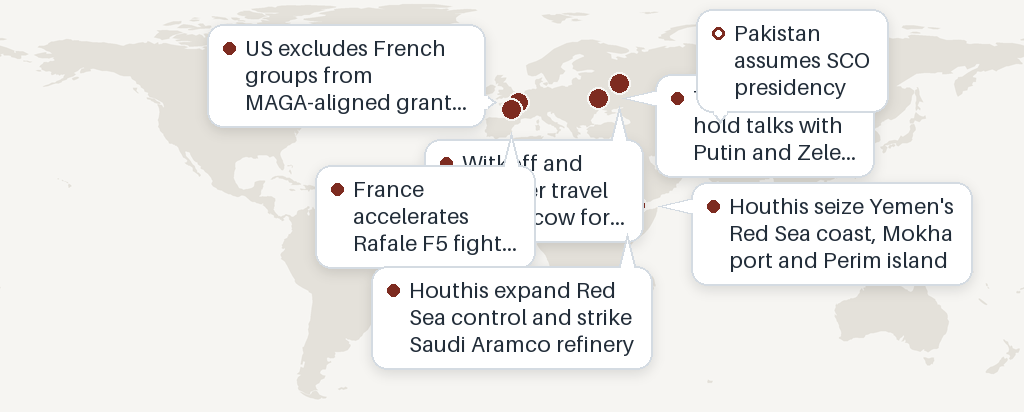
Where the latest issue's events happened.
1 US–China power transition
dormantbackgroundelevatedhotcritical
The structural rivalry between a rising China and the incumbent United States — the contemporary case of power-transition theory. Expressed through trade policy and tariffs, technology export controls and semiconductor competition, military balancing in the Indo-Pacific, alliance-building (Japan, Philippines, Australia, Taiwan relations), and periodic leader-level summitry that oscillates between détente and escalation. Taiwan is the highest-risk flashpoint; the South China Sea and the tech war are chronic pressure points. Watch for changes in behavior, not continuations: first-time military actions, crossed thresholds, new export-control categories, alliance commitments.
Europe's attempt to become an independent strategic actor: defense integration and rearmament, reduced security dependence on the United States, industrial and technology policy, energy security, and the internal tension between EU-level ambition and member-state sovereignty. Driven by doubts about US commitment and by the Russian threat. Watch: defense spending decisions, joint procurement, EU institutional changes, Franco-German dynamics, European positions taken independently of (or against) Washington.
Russia's attempt to restore and assert great-power standing beyond the battlefield (the war itself is tracked in the separate Ukraine-war storyline): hybrid operations against Europe (sabotage, election interference, cyber), influence operations in Africa and the Middle East, energy leverage, nuclear signaling, US–Russia diplomacy, and the deepening alignment with China, Iran, and North Korea. Watch: sanctions changes, attributed sabotage or interference incidents, nuclear-posture moves, diplomatic openings with Washington, new footholds abroad.
Read through: Deterrence Theory · Security Dilemma · Alliance Politics (Entrapment–Abandonment) · Power Transition / Thucydides Trap
4 The Ukraine war
dormantbackgroundelevatedhotcritical
The war itself, tracked as its own arc distinct from Russia's broader great-power pursuit: battlefield dynamics and territorial inflections, Ukraine's drone-centric military innovation and defense-industrial scale-up, the Western support pipeline (funding, weapons licenses, co-production), deep strikes into Russia, mobilization and political stability in both Kyiv and Moscow, and negotiation or ceasefire diplomacy. Watch for: first use of new weapon classes or permissions, battlefield inflection points, major aid or co-production decisions, domestic-political shocks in either capital, credible negotiation signals.
5 US–Iran confrontation and Middle East realignment
dormantbackgroundelevatedhotcritical
The escalating direct confrontation between the United States and Iran — now past the threshold from sanctions pressure into kinetic enforcement (naval blockade, strike campaigns) — embedded in a wider reordering of the Middle East: Israel's wars and their aftermath, activation or restraint of Iran's proxy network (Hezbollah, the Houthis, Iraqi militias), Gulf-state hedging between Washington, Beijing and Tehran, US-brokered stabilization frameworks (e.g. the Lebanon trilateral), and Iran's deepening alignment with Russia and China. Watch for: escalation thresholds crossed (strikes on Iranian soil vs proxies, blockade-enforcement incidents), proxy activation or stand-down, shipping and energy chokepoints (Hormuz, Bab el-Mandeb, Red Sea), nuclear-program signals, negotiation feelers, Gulf realignments.
18 curated feeds for the facts, analysis
outlets for the interpretation.
BBC World
The Guardian World
Al Jazeera
Politico Europe
War on the Rocks
Foreign Affairs
ECFR
CSIS
Atlantic Council
Breaking Defense
Defense One
The Diplomat
SCMP China
Lowy Interpreter
Moscow Times
Meduza
The War Zone
NYT World
III
The lenses
The lenses are well known International Relations theories. Every analyzed event is read through the lenses
attached to its storyline.
Security Dilemma
Measures one state takes for its own security (armament, alliances, forward deployments) are read by others as threatening, provoking countermeasures — a spiral of insecurity neither side sought. Severity depends on whether offensive and defensive postures are distinguishable and whether offense is perceived to have the advantage.
Deterrence Theory
An actor refrains from an action when the expected costs imposed by a defender exceed expected gains. Deterrence requires capability, credibility, and communication — and fails when any of the three is doubted. Distinguish deterrence by punishment from deterrence by denial, and general from immediate deterrence.
Power Transition / Thucydides Trap
War risk peaks when a rising power approaches parity with a dominant power AND is dissatisfied with the existing order (Organski; popularized by Allison). The mechanism is structural stress: the riser demands status and rule changes; the incumbent fears displacement; both face domestic pressure not to appear weak. Transition need not end in war — accommodation happened in 4 of Allison's 16 cases — but requires deliberate management.
Alliance Politics (Entrapment–Abandonment)
Allies constantly balance two fears: entrapment (being dragged into a partner's conflict) and abandonment (being left undefended). Patrons and clients manage this with ambiguity, conditionality, and reassurance. Third parties (a Corinth) can drag great powers into confrontations neither wanted.
Economic Interdependence & Weaponization
Deep economic ties raise the cost of conflict (liberal claim) but also create chokepoints that states weaponize — sanctions, export controls, infrastructure leverage (weaponized interdependence, Farrell/Newman). Interdependence deters war while simultaneously becoming a theater of it.
IV
How a week becomes a digest
Gather
Every week, hundreds of articles come in from the feeds.
Distill
They are clustered into events, everything routine is discarded.
Only the 5-6 developments that impact a storyline
survive. A quiet week is reported as a quiet week.
Analyze
Each key event is read through its storyline's theoretical
lenses, against the storyline's accumulated history: what happened, what
it rhymes with, what it changes, and what to watch next.
One email, Sunday morning, covering the storylines of your choice.
V
About
I'm Koen, a military historian, Navy reservist and software developer from Amsterdam. I built IR Lens for myself:
to better understand geopolitical events and how they impact the big stories they're part of.
IR Lens is the tool I wanted to exist: a helicopter view on current events for the geopolitical stories that interest me. If that sounds like how you want to follow the world, the
signup box is at the top of the page.
Questions, corrections, or storylines you think we should start tracking:
koen@dispatchdata.nl.